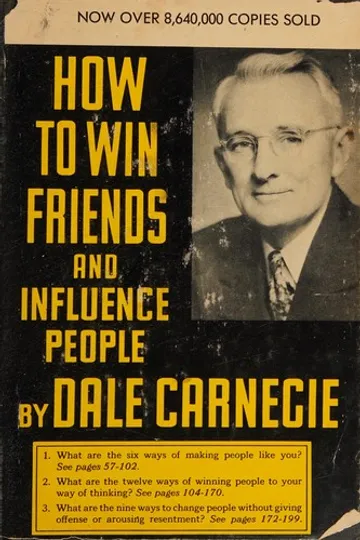
How to Win Friends and Influence People
by Dale Carnegie · 1936
The book in three sentences
- Dale Carnegie’s 1936 classic treats getting along with people as a skill anyone can learn, and, in today’s edition, breaks it down into 30 plain principles.
- Its core observation is that people care most about themselves and want to feel important, so criticism puts them on the defensive while sincere interest and appreciation win them over.
- The principles fall into four groups: handling people, making them like you, winning them to your way of thinking and changing their behavior without resentment.
5 min read · free, no account needed
Covers: Open Library
The key ideas of How to Win Friends and Influence People
Criticism doesn’t change anyone
Carnegie opens with the rule most people break every day: don’t criticize, condemn or complain. Criticism puts people on the defensive and sends them looking for excuses; he points out that even notorious criminals rarely blame themselves. It hurts their pride and leaves resentment behind long after the moment has passed. If you want someone to change, criticism is the tool least likely to get you there.
Try it For one day, stop every complaint before you say it, and count how many you caught.
Everyone wants to feel important
Citing the philosopher John Dewey, Carnegie puts one urge at the center of human nature: the desire to be important. Much of his advice follows from it. Honest appreciation satisfies it; criticism threatens it. He draws a sharp line between appreciation and flattery, though. Appreciation is sincere and freely given, flattery is insincere and self-serving, and people see through it. The principle only works when you mean it.
Try it Tell one person today exactly what you appreciated about something they did.
Start from what the other person wants
The third fundamental technique is to arouse an eager want in the other person. Carnegie’s image: you bait a fishing hook with what the fish likes, not with what you like. People act on their own wants, so before you ask for anything, work out what’s in it for them and talk about that. The same idea runs through several later principles, like talking in terms of the other person’s interests.
Try it Before your next request, write down one reason the other person would want to say yes.
Be interested, not interesting
None of the six ways to make people like you is about being impressive. Be genuinely interested in others, smile, remember their names, listen and get them talking about themselves, talk about what interests them, and make them feel important. Carnegie’s argument is that real interest in other people wins you far more friends than any effort to get them interested in you.
Try it In your next conversation, ask two follow-up questions before you say anything about yourself.
Nobody wins an argument
Even when you win an argument, you lose: the other person feels beaten, resents it and holds on to their view. So Carnegie’s first rule for persuasion is to avoid arguments altogether. Show respect for the other person’s opinion and never tell them flatly that they’re wrong. And if you’re the one who’s wrong, admit it quickly and emphatically; it takes the fight out of the conversation.
Try it Next time you disagree, ask a question about their view before you state yours.
Let them own the idea
People trust conclusions they reach themselves more than ones handed to them. So start in a friendly way and look for early agreement: each yes makes the next one easier, while an early no is hard to take back. Let the other person do most of the talking, and let them feel the idea is theirs. At work, the same logic favors asking questions over giving orders.
Try it Turn your next instruction into a question, and let the other person shape the answer.
Correct people without costing them their pride
When you need to change someone’s behavior, Carnegie’s leadership principles all protect the other person’s pride. Begin with honest praise, point out mistakes indirectly, mention your own mistakes first and let the person save face. Then praise every improvement, however small, and give them a fine reputation to live up to: treat them as if they already have the quality you want them to develop.
Try it Before correcting someone, name one thing they did well and one mistake you’ve made yourself.
How to Win Friends and Influence People cheat sheet: all 30 principles
All 30 principles in the four groups Carnegie uses, in plain words. The first two parts are about getting along with people; the last two are about persuading and leading them.
| Part | Principles |
|---|---|
| Handling peoplePart 1 · 3 principles |
|
| Making people like youPart 2 · 6 principles |
|
| Winning people to your way of thinkingPart 3 · 12 principles |
|
| Changing people without resentmentPart 4 · 9 principles |
|
The thread through all 30: people act on their own wants and their need to feel important, so start from their side of the conversation, not yours.
Test yourself
Recalling an idea fixes it better than rereading it. Try to answer before you look.
What is the first fundamental technique in handling people?
Show answer
Don’t criticize, condemn or complain.
Criticism makes people defensive; even notorious criminals rarely blame themselves.
Which deep human urge does Carnegie, citing John Dewey, put at the center?
Show answer
The desire to be important.
What is the first of the six ways to make people like you?
Show answer
Become genuinely interested in other people.
What is the only way to get the best of an argument?
Show answer
Avoid it.
Even when you win the argument, the other person resents losing it.
Free in the Web Highlights learner. No account needed.
Is How to Win Friends and Influence People worth reading?
Yes, if you can read past the dated stories. The principles are simple, still hold up and are much harder to practice than they sound.
Read it if
- you tend to win arguments and lose people
- you lead a team or deal with customers every day
- small talk with new people feels like hard work
Skim it if
- you’ve read modern books on persuasion or negotiation: much of this will feel familiar
- you just want the list: the cheat sheet above has all 30 principles
Where it falls short
- The evidence is anecdotal: stories about businessmen, politicians and students of Carnegie’s courses, not research.
- Used cynically, the techniques turn into manipulation; Carnegie insists on sincerity, but the book can still read like a set of tricks.
- The examples and the world they describe feel dated, and avoiding arguments can slide into avoiding honest disagreement.