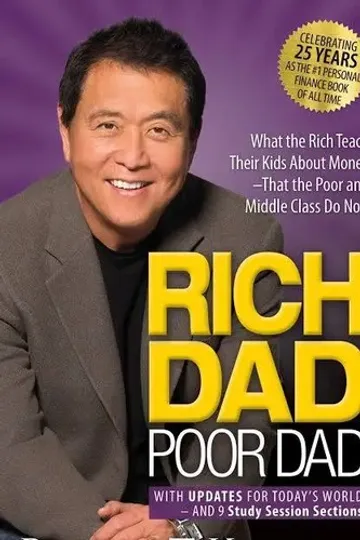
Rich Dad Poor Dad
by Robert T. Kiyosaki · 1997
The book in three sentences
- Rich Dad Poor Dad contrasts two father figures: Kiyosaki’s own father, highly educated but always short of money, and his best friend’s father, who never finished eighth grade and grew rich in business.
- Its central claim is that income doesn’t make you wealthy, financial literacy does: most people work for money, while the rich buy assets that put money in their pocket.
- The six lessons teach you to tell assets from liabilities, build your asset column first, learn the rules owners use and choose work for what it teaches.
5 min read · free, no account needed
Covers: Open Library
The key ideas of Rich Dad Poor Dad
Stop working for money
Rich dad paid young Robert ten cents an hour, then nothing at all. He wanted to show how fear of being without money and desire for what it buys keep most people trading their time for a paycheck. Instead of pushing for a raise, the boys spotted an opportunity and started a comic-book library. The skill to build: notice when emotion, not thinking, drives your money decisions.
Try it Before asking for a raise, list one way to earn that doesn’t cost more hours.
An asset puts money in your pocket
An asset puts money in your pocket; a liability takes money out. By that test, a new car and even your home count as liabilities, because they cost you every month. The rich buy things that produce income: businesses that run without them, stocks, bonds, rental property and royalties. The middle class buys liabilities it believes are assets.
Try it Sort what you own with one question: does it pay you or cost you?
A raise won’t get you out of the rat race
In the rat race, every raise brings bigger spending, so the bills grow as fast as the paycheck. Earning more doesn’t break the cycle; sending money into the asset column does, until the income it produces covers your expenses. The book measures wealth the same way, borrowing Buckminster Fuller’s definition: how many days you could keep your lifestyle if you stopped working today.
Try it Work out how many days you could live on your savings if your income stopped today.
Pay yourself first
Most people pay the bills first and save whatever is left, which is often nothing. Rich dad reverses the order: money goes into your asset column first, and the bills come after. Some months that leaves you short. The book treats that squeeze as useful, because it pushes you to find new ways to earn money rather than skip the investment.
Try it Set up an automatic transfer to savings or investments on the day you get paid.
Ask how you could afford it
Rich dad didn’t allow anyone to say they couldn’t afford something. That sentence ends the thinking, while asking how you could afford it starts it. Kiyosaki treats most money problems the same way: the biggest obstacles are inside you. He names five that stop even financially literate people from building assets: fear, cynicism, laziness, bad habits and arrogance.
Try it The next time you think you can’t afford something, write down three ways you could.
Owners and employees play by different tax rules
Kiyosaki argues that tax law treats employees and business owners differently. An employee earns, is taxed and spends what’s left. An owner earns, spends through a corporation and pays tax on what remains. Rich dad counts knowing the law as one of the four parts of financial IQ, next to accounting, investing and understanding markets. Tax rules vary by country, so treat this as a direction, not a plan.
Try it Ask an accountant what a small side business could deduct where you live.
Work to learn, not to earn
The last lesson is to choose jobs for what they teach you, not only for what they pay. Rich dad puts sales and communication above all other skills, and he values knowing a little about many parts of a business over knowing everything about one. Kiyosaki calls himself a best-selling author, not a best-writing one, to make the same point.
Try it Pick one skill, like selling or public speaking, and practice it on purpose this month.
Rich Dad Poor Dad cheat sheet: the six lessons
One row per lesson. The poor dad column stands for the money habits the book wants you to unlearn.
| Lesson | Rich dad | Poor dad |
|---|---|---|
| The rich don’t work for moneyLesson 1 | Make money work for youLook for opportunities, and don’t let fear or desire make your money decisions. | Work for a paycheckStudy hard, then find a secure job with good pay and benefits. |
| Why teach financial literacy?Lesson 2 | Learn to read the numbersWhat you keep matters more than what you earn. Buy assets, not liabilities. | Earn moreA higher income will fix money problems, and your home is your biggest asset. |
| Mind your own businessLesson 3 | Build your asset columnKeep your job, but treat your assets as your real business. Buy luxuries last. | Your job is your businessPut everything into your career, and buy the luxuries first. |
| The history of taxes and the power of corporationsLesson 4 | Learn the owners’ rulesEarn, spend through a corporation, then pay tax on what’s left. | The rich should pay moreEarn, get taxed, then live on whatever remains. |
| The rich invent moneyLesson 5 | Learn to manage riskUse financial knowledge to spot and create deals other people miss. | Play it safeAvoid risk and keep your money where it feels secure. |
| Work to learn, don’t work for moneyLesson 6 | Learn many skillsChoose jobs for what they teach, above all selling and communication. | SpecializeGo deep in one field and climb a secure career ladder. |
The test under all six: an asset puts money in your pocket and a liability takes money out. Buy assets first, and let their income pay for the luxuries you want.
Test yourself
Recalling an idea fixes it better than rereading it. Try to answer before you look.
How does Rich Dad Poor Dad define an asset?
Show answer
Something that puts money in your pocket.
Why does Kiyosaki argue your home is not an asset?
Show answer
It takes money out of your pocket every month — mortgage, taxes, upkeep — instead of bringing money in.
It is the book’s most debated claim.
What does “pay yourself first” mean in the book?
Show answer
Put money into your asset column before paying bills, and let the pressure push you to earn more.
Which phrase does rich dad forbid, and what does he ask instead?
Show answer
“I can’t afford it” — replaced by “How can I afford it?”
The first shuts your mind down; the second puts it to work.
Free in the Web Highlights learner. No account needed.
Is Rich Dad Poor Dad worth reading?
Worth reading as a mindset book, not a manual: it’s quick and memorable on why income alone won’t make you wealthy, but thin on concrete, current advice.
Read it if
- you earn a decent salary and still have little left each month
- nobody ever explained assets, liabilities or cash flow to you
- you want a quick, story-driven first book about money
Skim it if
- you already track your spending and invest regularly
- you only want the six lessons: the cheat sheet above covers them
Where it falls short
- Critics question whether rich dad existed as described, and much of the story can’t be checked; read it as a parable, not a memoir.
- The advice stays general and US-centric: little on diversification or low-cost index funds, and tax tactics that may not apply where you live.
- The deals it celebrates carry real risk, and it says little about how debt and leverage can magnify losses.