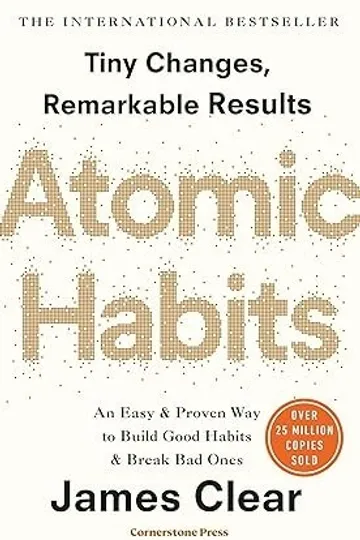
Atomic Habits
by James Clear · 2018
The book in three sentences
- Tiny improvements snowball: getting 1% better every day makes you about 37 times better in a year, but the results show up long after the effort.
- Lasting change starts with identity. Decide who you want to become, and let every small action prove it.
- To build a habit, make it obvious, attractive, easy and satisfying; to break one, turn all four around.
4 min read · free, no account needed
Covers: Open Library
The key ideas of Atomic Habits
1% better every day adds up to 37×
A 1% improvement is too small to notice on any single day, which is why most people give up on it. Kept up for a year, it makes you about 37 times better (1.01³⁶⁵ ≈ 37.8); slipping 1% a day takes you close to zero. The catch is timing: results lag behind effort, so the first weeks feel like nothing is happening. Clear calls this the plateau of latent potential. The work isn’t wasted; it’s stored.
Try it Judge a new habit after a month, not after a week.
Systems beat goals
People who succeed and people who don’t usually want the same thing, so the goal can’t be what separates them. The difference is the system: the daily routine that produces the result. Goals also end. Reach one, and the behavior behind it often stops. Clear’s advice is to keep the goal for direction and put your effort into the process.
Try it Write down the system behind your next goal: what you’ll do, when and where.
Change who you are, not just what you do
Clear describes three layers of change: outcomes (what you get), processes (what you do) and identity (what you believe about yourself). Most people start from the outside, with a result they want. He argues for starting at the center: not “I want to run a marathon” but “I’m a runner”. Every time you act like that person, you add a vote for that identity. No single vote decides it; the majority does.
Try it Finish the sentence “I’m the kind of person who…” and do one small thing today that proves it.
Every habit runs the same loop
Cue, craving, response, reward. The cue catches your attention, the craving makes you want the change it promises, the response is the habit itself, and the reward satisfies the craving and teaches your brain to repeat the loop. Each of the four laws works on one of these steps, which is why the whole method fits on one page.
Try it For a habit you want to break, name the cue that starts it.
Shape your environment instead of relying on willpower
People who seem to have iron self-control mostly spend less time around temptation. Clear treats your surroundings as the strongest lever you have: put the cue for a good habit where you can’t miss it (the book on your pillow, the water bottle on your desk) and move the cues for bad ones out of sight. Removing a temptation works better than fighting it.
Try it Tonight, move one cue into sight and one out of sight.
Start with two minutes
Scale any new habit down until it takes less than two minutes: read one page, put on your running shoes. The point isn’t the two minutes; it’s becoming someone who shows up every day. You can only improve a habit you actually do, and it becomes automatic through repetitions, not through time spent planning.
Try it Shrink your next new habit to its first two minutes.
Track it, and never miss twice
A visible record, like a calendar or a checklist, is a cue to act, a small reward when you tick it off and an honest signal when you slip. Slips are normal. What matters is the next day: one missed day is a blip, two in a row is how a habit quietly ends.
Try it If you miss a day, plan tomorrow’s repetition right now.
Atomic Habits cheat sheet: the four laws
Every row is one step of the habit loop. Read across to build a habit; use the right column to break one.
| Step | Build a good habit | Break a bad habit |
|---|---|---|
| Cue1st law | Make it obvious
| Make it invisible
|
| Craving2nd law | Make it attractive
| Make it unattractive
|
| Response3rd law | Make it easy
| Make it difficult
|
| Reward4th law | Make it satisfying
| Make it unsatisfying
|
The rule behind the fourth law: behavior that pays off right away gets repeated, and behavior that costs you right away gets dropped.
Test yourself
Recalling an idea fixes it better than rereading it. Try to answer before you look.
What are the four laws of behavior change?
Show answer
Make it obvious, make it attractive, make it easy, make it satisfying.
Each law acts on one step of the habit loop.
What is habit stacking?
Show answer
Linking a new habit to a current one: “After [current habit], I will [new habit].”
The existing habit becomes the cue for the new one.
What does the two-minute rule say?
Show answer
When you start a new habit, scale it down until it takes less than two minutes.
Master the habit of showing up before you optimize it.
What is the “plateau of latent potential”?
Show answer
The stretch where progress feels invisible because compounding results lag behind the effort.
Breakthroughs are usually the result of work done long before.
Free in the Web Highlights learner. No account needed.
Is Atomic Habits worth reading?
Yes, if you want one practical system rather than the science behind it. It’s short, concrete and easy to act on.
Read it if
- you set goals and drop them after a few weeks
- you want a method, not a stack of studies
- it’s your first book about habits
Skim it if
- you’ve read The Power of Habit or Tiny Habits: the habit loop and “start tiny” overlap a lot
- you mainly want the method: the cheat sheet above covers it
Where it falls short
- It’s a synthesis more than new research: the loop builds on Charles Duhigg’s cue, routine and reward, and starting tiny echoes BJ Fogg’s work.
- Most examples are success stories; you rarely hear from people the tactics didn’t help.
- Habits tied to addiction, depression or ADHD usually need more than environment design and a two-minute rule.