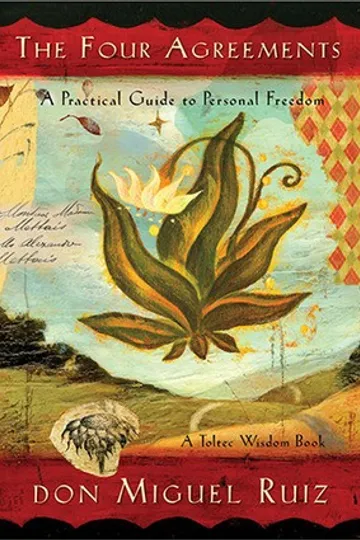
The Four Agreements
by Don Miguel Ruiz · 1997
The book in three sentences
- Don Miguel Ruiz argues that most of our unhappiness comes from beliefs we absorbed as children, through reward and punishment, and never chose for ourselves.
- He offers four new agreements to replace them: be impeccable with your word, don’t take anything personally, don’t make assumptions and always do your best.
- The agreements are easy to state and hard to keep, so the book asks you to practice them daily and to start again, without judging yourself, each time you slip.
5 min read · free, no account needed
Covers: Open Library
The key ideas of The Four Agreements
You were domesticated into your beliefs
Ruiz calls childhood a process of domestication. Parents, teachers and society reward us for following their rules and punish us for breaking them, until we accept those rules as the truth about the world and about ourselves. He calls the whole shared set of rules the dream of the planet. We never consciously agreed to it, yet it shapes what we fear, what we feel guilty about and how we judge other people.
Try it Pick one rule you live by and ask where you first learned it.
An inner Judge and Victim keep the old rules alive
Every belief we accepted ends up in what Ruiz calls the Book of Law, an inner rulebook the mind never questions. The Judge measures you against it and finds you guilty; the Victim accepts the verdict and carries the shame. Ruiz notes that an animal pays once for a mistake, while people punish themselves again every time they remember it. The four agreements are his way of rewriting that rulebook.
Try it When you catch yourself replaying an old mistake, remind yourself it’s already been paid for.
Words create, for better or worse
The first agreement, be impeccable with your word, rests on Ruiz’s view that words are never neutral. What you say can plant beliefs in other people, and in yourself, that keep growing for years. Impeccable, which he traces back to the idea of being without sin, means using words with integrity: meaning what you say and never turning words against yourself or anyone else. He compares gossip to a computer virus that passes false information from mind to mind.
Try it Go one full day without gossip and without putting yourself down.
What others do is about them
The second agreement, don’t take anything personally, follows from the idea that everyone lives in a dream of their own, built from their own beliefs. What people say and do reflects that inner world far more than any truth about you, even when it’s aimed straight at you. Ruiz calls the habit of making everything about ourselves personal importance and sees it as selfishness in its purest form. Once you stop taking things personally, other people’s moods and opinions lose most of their power to hurt you.
Try it The next time a remark stings, ask what it says about the speaker.
Ask instead of assuming
The third agreement targets a quiet habit: filling gaps with guesses, then treating the guesses as facts. We assume we know what others think, assume they know what we want without our saying it, take the imagined slight personally and react, and a conflict starts over nothing real. Ruiz’s remedy is plain: ask questions, even when it feels awkward, and say clearly what you want. It sounds obvious, but he treats it as a skill that takes courage.
Try it Before you react to a message that bothers you, ask one clarifying question.
Your best changes from day to day
The fourth agreement makes the other three workable. Your best isn’t a fixed standard: it looks different when you’re rested than when you’re tired or sick. Overdoing it drains you and still falls short, while holding back leaves you with guilt and gives the inner Judge material, so the aim is to give what the moment allows. Ruiz also asks you to act because you enjoy the action, not for a reward. Repeating this every day is how the first three agreements become habits.
Try it Tonight, name one thing you did your best at today, however small.
The Four Agreements cheat sheet: each agreement in practice
One row per agreement, in the book’s order: what it asks of you and a few ways to practice it this week.
| Agreement | What it means | In practice |
|---|---|---|
| Be impeccable with your word1st agreement | Use words honestly and with care, and never turn them against yourself or anyone else. |
|
| Don’t take anything personally2nd agreement | What people say and do comes from their own beliefs, so it isn’t a verdict on you. |
|
| Don’t make assumptions3rd agreement | Don’t treat your guesses about others as facts, and don’t expect people to read your mind. |
|
| Always do your best4th agreement | Give what the day allows, no more and no less; your best shifts with your energy and health. |
|
The fifth agreement: in The Fifth Agreement (2010), written with his son, Ruiz adds be skeptical, but learn to listen. Question what you hear, your own beliefs included, and listen for what people actually mean.
Test yourself
Recalling an idea fixes it better than rereading it. Try to answer before you look.
What are the four agreements?
Show answer
Be impeccable with your word, don’t take anything personally, don’t make assumptions, always do your best.
Why shouldn’t you take anything personally?
Show answer
What others say and do reflects their own beliefs and dream, not the truth about you.
Even a direct insult says more about the speaker than about you.
Why do assumptions cause suffering?
Show answer
We treat our guesses as true, take them personally and react — creating conflict out of nothing.
Why does your “best” change from day to day?
Show answer
It depends on the moment — rested or tired, healthy or sick — so you do the best you can under the circumstances.
Doing your best leaves the inner Judge nothing to punish.
Free in the Web Highlights learner. No account needed.
Is The Four Agreements worth reading?
Yes, if you want a short book built around one memorable framework. You can read it in an afternoon; living it takes much longer, and the book offers more encouragement than method.
Read it if
- you replay criticism in your head for days
- you often argue over what you thought someone meant
- you want a short, spiritual take on self-improvement
Skim it if
- you mainly want the agreements: the cheat sheet above has all four
- you prefer evidence-based psychology to spiritual language
Where it falls short
- The Toltec label is Ruiz’s framing, passed down in his family by his own account, not something historians can check; read it as spiritual teaching rather than history.
- Taken too far, not taking anything personally becomes a reason to wave off fair criticism, and the book says little about when feedback deserves a hearing.
- Terms like the dream, the Judge and the parasite are vivid but loose, and the book leans on repetition more than on practical techniques.