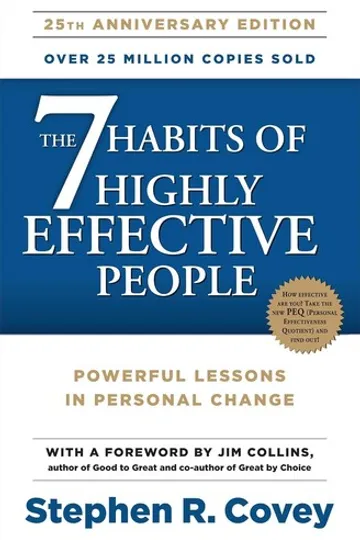
The 7 Habits of Highly Effective People
by Stephen R. Covey · 1989
The book in three sentences
- Stephen R. Covey argues that lasting effectiveness comes from character and timeless principles, built from the inside out, not from techniques for managing how others see you.
- His seven habits lead from dependence to independence to interdependence: habits 1–3 are the private victory of mastering yourself, habits 4–6 the public victory of working well with others.
- Habit 7, sharpen the saw, keeps the other six working by renewing your body, mind, spirit and relationships.
5 min read · free, no account needed
Covers: Open Library
The key ideas of The 7 Habits of Highly Effective People
Character comes before technique
Covey contrasts two ideas of success. The character ethic builds it on principles like integrity; the personality ethic relies on image, attitude and techniques. Techniques can work for a while, but when people sense you don’t mean them, trust breaks down. The habits are meant to change who you are, from the inside out.
Try it Pick one relationship where you rely on tactics, and ask what would build real trust.
Change how you see, not just what you do
A paradigm is the lens you see the world through: your mental map of how things are. Covey’s subway story shows how fast it can shift. A father’s noisy children seem simply rude until you learn their mother has just died, and irritation turns into sympathy at once. Techniques bring small improvements; a new way of seeing changes how you act.
Try it When someone irritates you today, write down one other explanation for their behavior.
Choose your response
Between what happens to you and how you respond, you have the freedom to choose, an idea Covey illustrates with Viktor Frankl’s experience in the Nazi concentration camps. Proactive people take responsibility for their responses instead of blaming circumstances or other people. They focus on their Circle of Influence, the concerns they can actually affect, and working there makes it grow.
Try it Split today’s worries into what you can influence and what you can’t; act on the first.
Decide what you want to be remembered for
Habit 2 rests on the idea that everything is created twice: first in the mind, then in reality. If you don’t design your life on purpose, circumstances and other people will. Covey’s exercise is to imagine your own funeral and what you’d want family, friends and colleagues to say about you. The answers become the raw material for a personal mission statement.
Try it Write three sentences you’d want a close friend to say about you.
Make time for the important, not the urgent
Habit 3, put first things first, turns your priorities into a schedule. Covey’s time management matrix sorts tasks by urgency and importance. Effective people protect Quadrant II, work that’s important but not urgent: planning, prevention, relationships and renewal. Because nothing forces it, it keeps getting pushed aside, and that neglect is what feeds tomorrow’s crises.
Try it At the start of each week, schedule one important, non-urgent task before anything else.
Trust works like a bank account
Covey describes the trust in a relationship as an Emotional Bank Account. Kindness, kept promises and integrity are deposits; broken promises and discourtesy are withdrawals. With a high balance, mistakes are forgiven and communication is easy. Habit 4, think win-win, builds on that trust: look for agreements that benefit both sides, and if you can’t find one, agree on no deal rather than let one side lose.
Try it Keep one small promise today that you’d normally let slide.
Listen to understand before you reply
While someone is talking, you’re usually already preparing your answer. Habit 5 asks you to seek first to understand, then to be understood. Empathic listening means getting inside the other person’s frame of reference, feelings as well as words, before you offer advice. Only then do you make your case: credibility first, then feeling, then logic.
Try it In your next disagreement, restate the other person’s view until they agree you’ve got it right.
The 7 Habits cheat sheet: all seven habits
All seven habits in order, with what each one means and how to put it into practice.
| Habit | What it means | In practice |
|---|---|---|
| Be proactiveHabit 1 · private victory | Take responsibility for your responses: between what happens and how you react, you choose. |
|
| Begin with the end in mindHabit 2 · private victory | Know where you want to end up; everything is created first in the mind, then in reality. |
|
| Put first things firstHabit 3 · private victory | Organize your time around your priorities, not around whatever feels urgent. |
|
| Think win-winHabit 4 · public victory | Look for agreements that benefit both sides, not a winner and a loser. |
|
| Seek first to understand, then to be understoodHabit 5 · public victory | Listen until you understand the other person, then make your own case. |
|
| SynergizeHabit 6 · public victory | Value differences, so working together produces more than either side alone. |
|
| Sharpen the sawHabit 7 · renewal | Renew yourself regularly, so you keep the capacity to practice the other six. |
|
Why the order matters: private victory comes before public victory. Habits 1–3 make you independent, habits 4–6 let you work well with others, and habit 7 renews all of them.
Test yourself
Recalling an idea fixes it better than rereading it. Try to answer before you look.
What are the 7 habits of highly effective people?
Show answer
Be proactive; begin with the end in mind; put first things first; think win-win; seek first to understand; synergize; sharpen the saw.
What are the Circle of Concern and the Circle of Influence?
Show answer
Everything you care about versus the part you can actually affect; proactive people focus on the second.
Working inside your Circle of Influence makes it grow.
In Covey’s time management matrix, where do effective people focus?
Show answer
Quadrant II: important but not urgent — planning, prevention, relationships and renewal.
What is empathic listening?
Show answer
Listening with the intent to understand the other person’s frame of reference, not to reply.
Covey ranks it above ignoring, pretending, selective and attentive listening.
Free in the Web Highlights learner. No account needed.
Is The 7 Habits of Highly Effective People worth reading?
Yes, if you’ll read it slowly and try the exercises. It’s long and sometimes preachy, but its framework for priorities and relationships still holds up.
Read it if
- you’re busy all the time but not sure you’re working on what matters
- you want a framework for work and relationships, not just productivity tips
- you’re willing to do exercises like writing a mission statement
Skim it if
- you already plan with the Eisenhower matrix: Habit 3 will feel familiar
- you mainly want the list: the cheat sheet above covers all seven habits
Where it falls short
- It’s long and repetitive; the core ideas would fit in a much shorter book.
- The support comes mostly from stories about Covey’s family, students and clients, not from research.
- The tone can feel preachy, and the principles it calls timeless are stated more than argued for.