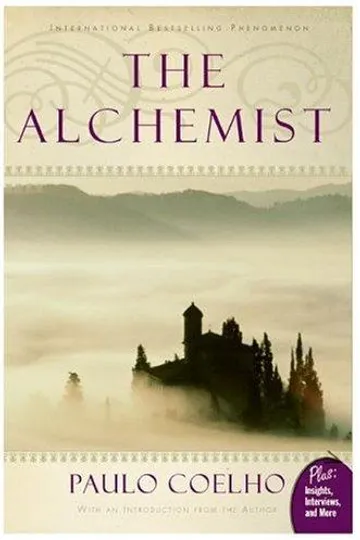
The Alchemist
by Paulo Coelho · 1988
The book in three sentences
- A young Andalusian shepherd named Santiago keeps dreaming of a treasure near the Egyptian pyramids, and he gives up his flock to go and find it.
- On the way he is robbed, works for a crystal merchant, crosses the Sahara, falls in love at an oasis and learns from an alchemist to read omens and trust his heart.
- The treasure turns out to lie back where he started, and Coelho’s point is that chasing your Personal Legend is worth it anyway: the journey is what changes you.
5 min read · free, no account needed
Covers: Open Library
The key ideas of The Alchemist
Everyone has a Personal Legend
The novel’s central idea is the Personal Legend: what you have always wanted to accomplish, which Coelho treats as the purpose each person is here to fulfill. The old king tells Santiago that young people know theirs, but over the years most are persuaded it can’t be done. Its promise is that once you truly commit, the world starts working in your favor.
Try it Write down what you wanted to do before anyone told you it was unrealistic.
Most people settle, and the novel shows how
Santiago keeps meeting people who stopped short. The baker wanted to travel but chose a trade people respected. The crystal merchant dreams of a pilgrimage to Mecca and never goes, because he’d rather keep the dream than risk living it. Even his sheep stand for the comfortable life: fed and watered, they follow wherever they’re led.
Try it Name one dream you keep safe by never starting it.
The world speaks in omens
Omens are the signs through which, in the novel, the universe guides you toward your Personal Legend. The old king gives Santiago two stones, Urim and Thummim, to help him read them, but tells him to make his own decisions. Later, a vision of two hawks fighting lets him warn the oasis of an attack. The lesson is attention: the guidance is there if you look.
Try it Look back at a big decision and list the signs you noticed, or ignored, beforehand.
Beginner’s luck comes first, the hard test last
The novel explains early success with the principle of favorability: when you first step onto your path, life hands you some easy wins to pull you forward. It also warns that every real search ends with a severe test, when the luck runs out and quitting looks sensible. Santiago’s hardest trials come near the end of his journey, in the desert, not at the start.
Try it When a new project stalls, ask whether this is the test, not proof you were wrong.
Choose the story you tell yourself
On his first day in Tangier, a man who offered to guide him runs off with all of Santiago’s money. He can see himself as the victim of a thief or as an adventurer looking for treasure, and he chooses the adventurer. The facts stay the same; what he does next changes. The camel driver adds a related lesson: live in the present and give today your full attention.
Try it Retell a recent setback as part of an adventure and notice what you’d do next.
Listen to your heart, and don’t let fear decide
The alchemist teaches Santiago that his heart knows where the treasure lies and speaks the Language of the World, the wordless language of omens, intuition and love that connects everything. When Santiago admits his heart is afraid, the alchemist answers that being afraid of pain holds you back more than the pain ever would. Love is tested too: Fatima wants Santiago to keep going, because in the novel true love never stands in the way of a Personal Legend.
Try it Name the fear behind one choice you keep postponing, and ask what waiting has cost you.
The treasure was near home all along
After crossing the desert, Santiago digs at the pyramids and is beaten by strangers. Their leader scoffs that he once dreamed of treasure under a sycamore at a ruined church in Spain, the very church where Santiago’s journey began. The trip wasn’t wasted: only the journey could show him where the treasure was, and turn the shepherd into someone able to find it.
Try it Think of a detour in your life that taught you what a straight path couldn’t.
The Alchemist cheat sheet: key ideas and symbols
The ideas the novel keeps returning to, what each one means in the story and the lesson it carries.
| Idea | In the story | The lesson |
|---|---|---|
| Personal Legend | What Santiago has always wanted to accomplish, and the purpose the novel says each person is meant to fulfill. | Name your own, and don’t let fear or comfort talk you out of it. |
| Omens | Signs through which the world guides Santiago, like the two hawks whose fight warns him of an attack on the oasis. | Guidance shows up in everyday events if you pay attention. |
| Beginner’s luck | The principle of favorability: early success that pulls a newcomer onto the path. | Enjoy the early wins, and expect a hard test before the end. |
| Maktub | An Arabic word meaning “it is written”; Santiago hears it from the crystal merchant. | Some things are meant to happen; accept them and keep moving. |
| The Language of the World | The wordless language of omens, intuition and love that all things share. | Much of what matters is understood without words. |
| The Soul of the World | The force that connects all things; Santiago draws on it when he has to turn himself into the wind. | A real commitment connects you to something larger than yourself. |
| Alchemy | The craft of turning metal into gold, which the Englishman studies in books and the alchemist actually performs. | People, like metal, are refined into their best selves by pursuing their Personal Legend. |
| The treasure | Buried under the sycamore at the ruined church in Spain where Santiago’s journey began. | What you’re looking for may be close, but only the journey shows you where. |
The four obstacles: in his introduction to later editions, Coelho names what stops people: being told it’s impossible, love for the people around them, fear of defeat and fear of actually reaching the dream.
Test yourself
Recalling an idea fixes it better than rereading it. Try to answer before you look.
What is a Personal Legend?
Show answer
What you have always wanted to accomplish — the purpose each person is meant to fulfill.
What are omens in The Alchemist?
Show answer
Signs through which the universe speaks, guiding a person toward their Personal Legend.
What is beginner’s luck, according to the novel?
Show answer
The principle of favorability: life grants early success to spur newcomers on toward their dream.
The novel adds that every search ends with the seeker being severely tested.
What is the lesson of the novel’s ending?
Show answer
The treasure was near home all along, but only the journey could reveal it and change him.
Free in the Web Highlights learner. No account needed.
Is The Alchemist worth reading?
Yes, as a short fable you can read in a sitting or two and return to when you’re weighing a big change. Read it for its lessons, not for complex characters or plot.
Read it if
- you’re weighing a risky change and want encouragement
- you like fables and parables more than realistic novels
- you want a short book with one clear message
Skim it if
- you know the story and want the ideas: the cheat sheet above covers them
- you prefer novels with complex characters and a less direct message
Where it falls short
- Its message, that the universe helps anyone who truly pursues a dream, glosses over people held back by circumstances rather than by fear.
- Fatima is thinly drawn: her part is mostly to wait at the oasis while Santiago travels.
- The prose is deliberately simple and spells out its lessons, which some readers find wise and others find preachy.