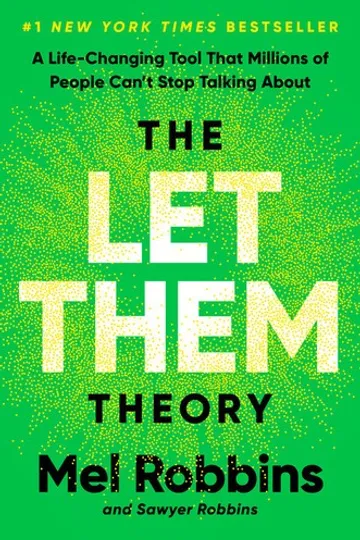
The Let Them Theory
by Mel Robbins · 2024
The book in three sentences
- Mel Robbins builds this book on two short phrases: Let Them, which means letting other people think, feel and do what they will, and Let Me, which means taking responsibility for what you do next.
- Much of our stress, she argues, comes from trying to manage other people’s opinions, moods and choices, when the only things you actually control are your own thoughts, actions and responses.
- She then applies the pair to stress, other people’s opinions, comparison, friendship and love, including the hard case of someone you wish would change.
5 min read · free, no account needed
Covers: Open Library
The key ideas of The Let Them Theory
Let Them is only half the tool
It’s easy to hear “let them” as a shrug. Robbins insists on the second half. Let Them releases what other people think, say and do: their opinions, their plans, their moods. Let Me is where your power sits, in how you respond, what you do next and what you will accept. The phrase came from her daughter Kendall, who told her to “let them” while Robbins tried to manage her son’s prom plans. Letting go is the first step; choosing your response is the point.
Try it Next time someone frustrates you, say “let them,” then name one thing you’ll do next.
Other people’s opinions and moods aren’t yours to manage
You can’t stop people from thinking badly of you, and worrying won’t change their minds, so Robbins says let them and keep living by your own values. Another adult’s emotional outburst is theirs to handle; your part is your response and your boundaries. The same goes for disappointing someone: when a choice follows your values, their reaction isn’t proof you chose badly. Stress, which she describes as the brain switching into survival mode, eases once you stop fighting what you can’t control.
Try it When stress rises, take one slow breath before you decide how to respond.
Use comparison as a teacher
Envy feels bad, but Robbins treats it as information: it points at something you want and could work toward. If a friend’s new job stings, that sting may be telling you something about your own ambitions. Comparing yourself on things you can’t change teaches you nothing; that kind of comparison is only torture, and it’s the kind to let go. The useful question is whether the thing you envy is something you could build, one step at a time.
Try it The next time you feel envy, write down what it says you want.
Friendships fade for ordinary reasons
Robbins names three pillars of friendship: proximity, timing and energy. When one of them shifts, because someone moves or enters a new chapter of life, friendships fade, and it’s rarely anyone’s personal failure. The biggest shift is what she calls the Great Scattering, when friends from school spread out to different places and life stages. Close friendships take time, more than 200 hours together by the research she cites, so as an adult you have to go first: start the conversation, make the invitation, keep showing up.
Try it Send one invitation this week instead of waiting to be invited.
You can’t make anyone change
People change when they feel like it, not when they’re told to. Because we’re wired to want control, pressure triggers resistance and drags the problem out. Robbins offers the ABC Loop instead: Apologize for past pressure and ask open questions, Back off and observe, then Celebrate small wins. Modeling helps too, since people adopt behaviors they see others enjoying. And stop rescuing: taking away the consequences can keep someone stuck. Support means creating an environment that helps them heal, without solving their problems for them.
Try it Replace one piece of advice you keep repeating with an open question.
Let them show you who they are
Words are easy; behavior tells you how much you matter to someone. Robbins’s advice is to believe what people do over what they say. In dating, someone who keeps you guessing has already answered. None of this means tolerating anything. Let Them means you stop trying to control other people, not that you stop deciding what you accept. Boundaries belong to Let Me.
Try it Think of a relationship where words and actions don’t match, and decide what you’ll accept.
The Let Them Theory cheat sheet: Let Them and Let Me
The same two steps work in every situation: release what the other person thinks, feels or does, then decide what you’ll do.
| Situation | Let Them | Let Me |
|---|---|---|
| Someone thinks badly of you | Let them have their opinion. | Let me live by my own values anyway. |
| Another adult has an emotional outburst | Let them have their reaction. | Let me choose my response and set a boundary. |
| Stress about what you can’t control | Let them do what they’re going to do. | Let me take a breath and choose my response. |
| Your choice disappoints someone | Let them be disappointed. | Let me stand by a decision that fits my values. |
| Someone has what you want | Let them succeed. | Let me learn from the envy and work toward it. |
| A friendship fades | Let them move into a new chapter. | Let me go first and make new friends. |
| You want someone to change | Let them change when they’re ready. | Let me model the change and use the ABC Loop. |
| Someone you love is struggling | Let them face their own consequences. | Let me create an environment that helps them heal. |
| Words and actions don’t match | Let them show you who they are. | Let me believe their behavior and decide what I accept. |
Not a free pass: Let Them never means tolerating everything. You stop controlling other people, but you still decide what you accept and where your boundaries are.
Test yourself
Recalling an idea fixes it better than rereading it. Try to answer before you look.
What are the two halves of the Let Them Theory?
Show answer
“Let Them” — release others to be who they are — and “Let Me” — take responsibility for what you do next.
How does Robbins reframe comparison?
Show answer
As a teacher: envy points to what you want and can work toward.
Comparing traits you can’t change is only torture — let that kind go.
What are the three pillars of friendship?
Show answer
Proximity, timing and energy.
What is the ABC Loop?
Show answer
A way to influence someone: apologize and Ask open questions, Back off and observe, Celebrate small wins.
Free in the Web Highlights learner. No account needed.
Is The Let Them Theory worth reading?
Worth it if you spend real energy on what other people think or do. The tool is simple enough to use after the first chapter; the rest of the book applies it to one area of life after another.
Read it if
- you replay other people’s opinions of you for days
- you keep trying to fix or change someone close to you
- your adult friendships have thinned out and you’re not sure why
Skim it if
- you know Stoicism or radical acceptance: the core idea will feel familiar
- you only want the tool: the cheat sheet above covers the pairs
Where it falls short
- The core idea isn’t new: it restates Stoic acceptance and detachment in two catchy words, and a full-length book built on it gets repetitive.
- Taken as a slogan, “let them” can slide into shrugging off people who need an honest conversation; the book’s caveats about boundaries and Let Me are easier to forget.
- It leans on personal stories and brief references to research, so it reads more like a coaching book than a careful look at the evidence.