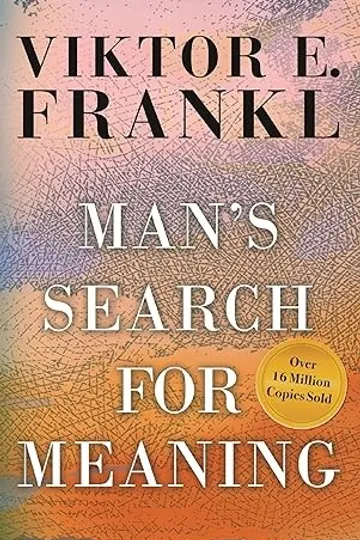
Man’s Search for Meaning
by Viktor E. Frankl · 1946
The book in three sentences
- Viktor Frankl, a Viennese psychiatrist, was imprisoned in four Nazi camps, including Auschwitz, and lost his wife, parents and brother in the Holocaust.
- Written soon after the war, this short book describes what he saw there: people could bear almost any suffering if they had a reason to live, and one freedom remained when everything else was taken, the freedom to choose their attitude.
- Later editions add a short second part on logotherapy, the psychotherapy he built on the search for meaning, which he saw as the deepest human drive.
5 min read · free, no account needed
Covers: Open Library
The key ideas of Man’s Search for Meaning
The one freedom no one can take away
In the camps, prisoners were stripped of nearly everything: family, possessions, even their names, replaced by numbers. Frankl observed that one thing remained. Each person could still choose the attitude they took toward what was happening, and some used it to comfort others and share what little they had. He calls this the last of the human freedoms. It doesn’t make suffering acceptable or excuse those who caused it; it means circumstances don’t get the final word on who you are.
Try it When something hard happens that you can’t change, ask which attitude toward it you could stand behind.
A reason to live makes hardship bearable
Frankl returns often to Nietzsche’s idea that a reason to live makes almost any hardship bearable. In the camps he saw prisoners hold on because something was waiting for them, someone who needed them or a task only they could finish. For Frankl it was his wife, whom he talked to in his mind on forced marches, and the manuscript taken from him at Auschwitz, which he meant to rewrite. Prisoners who lost all hope in the future often gave up.
Try it Write down one person or task you want to be there for.
Three ways to find meaning
Logotherapy names three places where meaning can be found. The first is creating a work or doing a deed. The second is experiencing something, such as beauty or nature, or loving another person. The third is the attitude you take toward suffering you cannot avoid. That third path is easy to misread. Frankl doesn’t say suffering is necessary: if it can be avoided or its cause removed, that’s what you should do. Meaning in suffering applies only when nothing can be changed.
Try it Name one source of meaning in your life right now for each of the three ways.
Ask what life expects of you
Frankl turns the usual question around. Instead of asking what we can expect from life, he suggests that life is asking something of us, and that we answer through our actions and choices rather than by thinking about it. There is no single meaning of life that fits everyone; it differs from person to person and from one moment to the next. That’s why he paired freedom with responsibility, and even proposed a Statue of Responsibility to balance the Statue of Liberty.
Try it Instead of asking what you want from this week, ask what this week asks of you.
Happiness follows; it can’t be chased
Frankl argues that happiness doesn’t work as a target. Make it your goal and it keeps its distance; commit to a cause or to another person, and it tends to show up on its own. Without it, people can fall into what he calls the existential vacuum, a sense of emptiness that often shows up as boredom, like the low mood some feel when a busy week ends. Pleasure, money or power often rush in to fill the gap, but in his view they are substitutes for meaning.
Try it Spend your next free afternoon on a person or cause beyond yourself.
Logotherapy puts meaning first
Frankl called his approach logotherapy, from the Greek logos, meaning. Freud had stressed the will to pleasure and Adler the will to power; Frankl put the will to meaning first, and his school became known as the Third Viennese School of Psychotherapy. Two of its techniques stand out. Paradoxical intention asks patients to deliberately wish for what they fear, which weakens the fear. Dereflection turns attention away from yourself and your symptoms toward something or someone else.
Try it When you’re caught up in worrying about yourself, spend an hour on someone else’s need.
Man’s Search for Meaning cheat sheet: Frankl’s core ideas
The book’s main ideas in one table, from what Frankl observed in the camps to the core of logotherapy.
| Idea | What it means |
|---|---|
| Three phases in the camps |
|
| The last human freedom | Whatever is taken from you, you can still choose your attitude toward it. |
| The will to meaning | The deepest human drive, ahead of the will to pleasure (Freud) and the will to power (Adler). |
| Three ways to find meaning |
|
| What life asks of you | Meaning is specific to each person and each moment, and you answer life through what you do. |
| Happiness as a side effect | It follows from dedication to a cause or a person; chased directly, it slips away. |
| The existential vacuum | A widespread feeling of emptiness, often felt as boredom; Sunday neurosis is one form of it. |
| Tragic optimism | Saying yes to life in spite of pain, guilt and death, the tragic triad. |
| Logotherapy | Frankl’s meaning-centered psychotherapy. Two techniques:
|
Keep in mind: Frankl never calls suffering necessary. If it can be avoided, avoid it; meaning in suffering applies only to what truly can’t be changed.
Test yourself
Recalling an idea fixes it better than rereading it. Try to answer before you look.
What does Frankl call the last of the human freedoms?
Show answer
The freedom to choose your attitude in any circumstances — the one thing no one can take away.
What are the three ways to discover meaning, according to Frankl?
Show answer
Creating a work or doing a deed; experiencing something or loving someone; the attitude you take toward unavoidable suffering.
How does logotherapy differ from Freud and Adler?
Show answer
Freud stressed the will to pleasure and Adler the will to power; Frankl puts the will to meaning first.
How does Frankl turn the question of life’s meaning around?
Show answer
Stop asking what we expect from life, and ask what life expects from us.
Free in the Web Highlights learner. No account needed.
Is Man’s Search for Meaning worth reading?
Yes. It’s short, and it pairs a firsthand account of the camps with a clear, humane view of what makes life worth living. Read the first part slowly; the second is brief and more technical.
Read it if
- you’re facing a loss or a situation you can’t change
- you want a firsthand account of the camps from a psychiatrist’s point of view
- you often ask what your life or work is for
Skim it if
- you mainly want logotherapy: the cheat sheet above covers its core terms
Where it falls short
- The logotherapy part is short and dense, more an outline of a theory than a full account of it.
- Some critics argue that its focus on inner attitude can be read as if meaning decided who survived, when survival in the camps depended mostly on chance, as Frankl himself acknowledges.
- It offers a way of seeing rather than a method, so readers who want concrete steps get few.