The 7 Habits of Highly Effective People: Key Ideas
Stephen R. Covey’s The 7 Habits of Highly Effective People (1989) is a principle-centered program for personal and professional effectiveness. These 26 cards cover all seven habits, how they build from private victory to public victory, and the tools Covey attaches to them — from the Circle of Influence to the time management matrix.
Read the summary of The 7 Habits of Highly Effective People →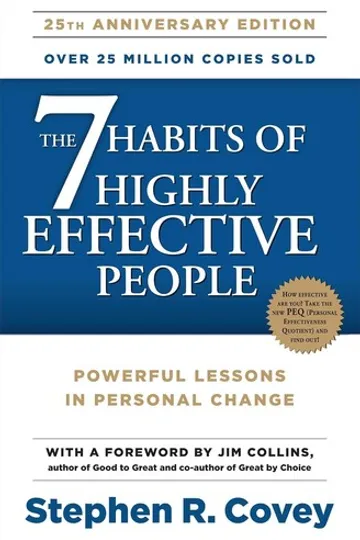
Practice this set for free — no account needed. Loads 26 flashcards into the learner.
Practice in the free learnerHow to study this set
Memorize the seven habits as a sequence: 1–3 are about mastering yourself, 4–6 about working with others, 7 about renewal. Then attach each tool card to the habit it belongs to.
All 26 flashcards
What is the core idea of The 7 Habits of Highly Effective People?
Lasting effectiveness comes from character and timeless principles, built from the inside out — not from techniques.
What are the 7 habits of highly effective people?
Be proactive; begin with the end in mind; put first things first; think win-win; seek first to understand; synergize; sharpen the saw.
How does Covey contrast the character ethic with the personality ethic?
The character ethic rests success on principles like integrity; the personality ethic relies on image, attitude and techniques.
What is a paradigm, in Covey’s sense?
The lens through which we see the world — our mental map of how things are.
His subway story: a father’s noisy children look different once you learn their mother has just died.
How does Covey define a habit?
The intersection of knowledge (what and why), skill (how) and desire (want to).
What is the maturity continuum?
The growth from dependence to independence to interdependence.
Which habits make up the Private Victory?
Habits 1–3, which move you from dependence to independence.
Which habits make up the Public Victory?
Habits 4–6, which build effective interdependence with others.
What is Habit 1?
Be proactive.
Take responsibility for your responses instead of blaming conditions or other people.
What lies between stimulus and response, according to Habit 1?
The freedom to choose, using self-awareness, imagination, conscience and independent will.
Covey illustrates it with Viktor Frankl’s experience in the camps.
What are the Circle of Concern and the Circle of Influence?
Everything you care about versus the part you can actually affect; proactive people focus on the second.
Working inside your Circle of Influence makes it grow.
What is Habit 2?
Begin with the end in mind.
Covey asks readers to picture their own funeral and what they would want said about them.
What does Covey mean by “all things are created twice”?
Everything is first created in the mind, then in reality — so design your life before you build it.
Which tool does Covey recommend for Habit 2?
A personal mission statement grounded in principles and values.
What is Habit 3?
Put first things first.
In Covey’s time management matrix, where do effective people focus?
Quadrant II: important but not urgent — planning, prevention, relationships and renewal.
What is the Emotional Bank Account?
A metaphor for trust in a relationship: kindness and kept promises are deposits, broken promises are withdrawals.
What is Habit 4?
Think win-win.
What does “win-win or no deal” mean?
If no solution benefits both sides, agree not to make a deal rather than let one side lose.
It is the last of Covey’s six paradigms of human interaction, after win-win, win-lose, lose-win, lose-lose and win.
What is Habit 5?
Seek first to understand, then to be understood.
What is empathic listening?
Listening with the intent to understand the other person’s frame of reference, not to reply.
Covey ranks it above ignoring, pretending, selective and attentive listening.
Which three Greek terms guide being understood in Habit 5?
Ethos (credibility), pathos (feeling) and logos (logic) — in that order.
What is Habit 6?
Synergize.
When differences are valued, the whole becomes greater than the sum of its parts.
What is Habit 7?
Sharpen the saw.
What are the four dimensions of renewal in Habit 7?
Physical, spiritual, mental and social/emotional.
What is the P/PC balance?
Balancing production (the results you want) with production capability (what produces them).
Covey draws it from Aesop’s goose that laid the golden eggs.