
I read a lot online, and I highlight a lot. For a long time, that was my whole system: mark the good parts, come back later, read them again. It felt like studying. It wasn't — a week later, most of it was gone anyway.
The fix wasn't reading more. It was a small change in direction: instead of putting information into my head again and again, I started pulling it out . That's active recall. It's the reason I built a learning feature into my highlighter at all — and in this article I'll show you how to use it on anything you read.
What Is Active Recall?
Active recall means testing yourself on what you want to remember instead of passively reviewing it. You close the book, hide the answer, and try to retrieve the information from memory — before checking whether you got it right.
That's the whole method. No apps required, no color-coded system. A question, an honest attempt to answer it, and a check. Researchers call it retrieval practice , and the act of retrieving is what makes the memory stronger.
The counterintuitive part? Struggling is the point. When an answer doesn't come easily and you dig for it anyway, your brain treats that information as something worth keeping.
Why Active Recall Works (and Re-Reading Doesn't)
Re-reading feels good because the text becomes familiar. But familiar is not the same as remembered. You see the highlighted sentence and think "I know this," when what you actually know is that you've seen it.
You don't remember what you read. You remember what you're asked.
The research on this is unusually clear. In a well-known 2006 study by Roediger and Karpicke , students either re-read a text or tested themselves on it. A week later, the self-testing group remembered significantly more — even though the re-reading group felt more confident. The authors end their abstract with one sentence that has stuck with me ever since:
Testing is a powerful means of improving learning, not just assessing it. — Roediger & Karpicke, Psychological Science (2006)
And in a large 2013 review, Dunlosky and colleagues rated common study techniques: practice testing came out among the most effective, while re-reading and highlighting on their own ranked near the bottom.
That last part is worth being honest about, coming from someone who built a highlighter: highlighting alone doesn't make you remember. It's the capture step — it marks what deserves your attention. What you do with those highlights afterwards decides whether they stick. I wrote more about that side of the equation in my article on learning retention .
Active Recall vs. Passive Review
Here's the difference in practice:
- Passive review: re-reading notes, re-watching lectures, scanning your highlights, listening to a summary again.
- Active recall: answering a question from memory, explaining a concept out loud, writing down everything you remember on a blank page.
A simple test: if you could do your "studying" while half-watching Netflix, it's passive. Active recall is uncomfortable in a way passive review never is — and that discomfort is a good sign, not a problem.
How to Practice Active Recall on Anything You Read
You don't need a system overhaul. Here's the loop I use:
- Highlight with intent. While reading an article, PDF, or even a YouTube transcript, mark only what you'd genuinely want to remember in a month. A handful of good highlights beats a page full of yellow.
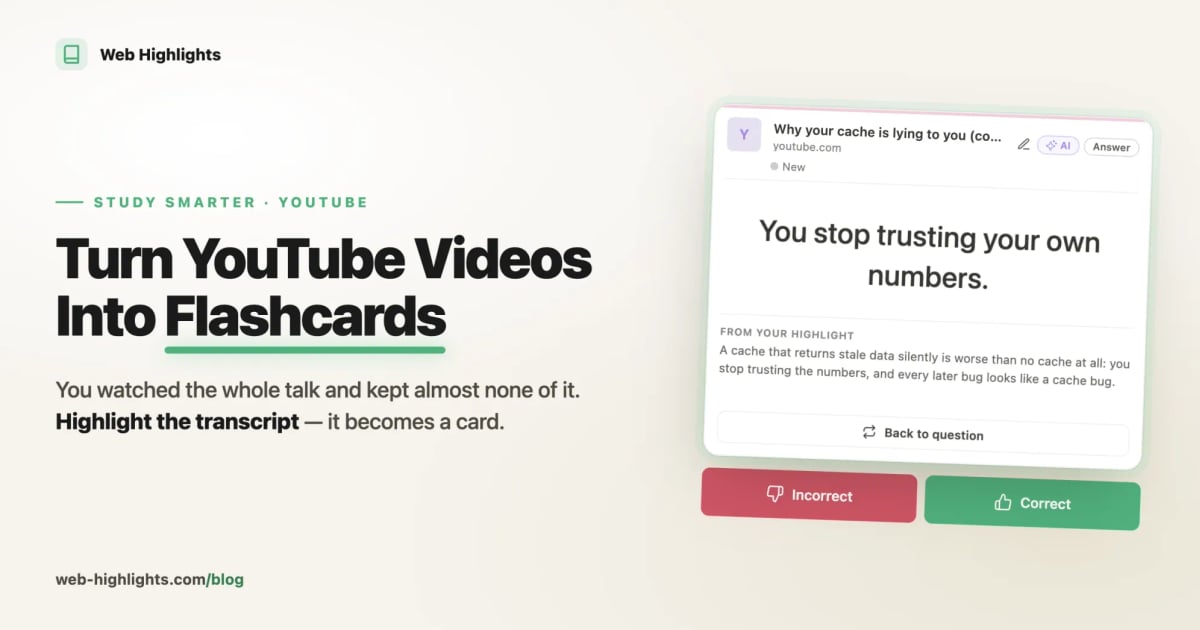
- Turn highlights into questions. Most highlights are really the answer half of a flashcard. "Spacing effect: reviews spread over time beat cramming" becomes "Why do spaced reviews beat cramming?" Phrasing the question is itself a round of recall.
- Answer before you peek. Later — ideally the next day — go through your questions and answer each one from memory. Out loud or on paper works better than "in your head," because you can't fool yourself.
- Check, grade honestly, repeat. Got it right? Wait longer before the next review. Got it wrong? See it again soon. Wrong answers aren't failures — they show you what to review next.
The blank-page method is a great low-tech variant: after finishing a chapter, close it and write everything you remember on an empty page. Then compare against the source. What you missed is exactly what needs another pass.
An Example: Active Recall on a YouTube Video
Here is how the loop can work on a YouTube video. Every video has a transcript behind it, and a transcript is just text — so you can open it next to the player and read along at your own speed.
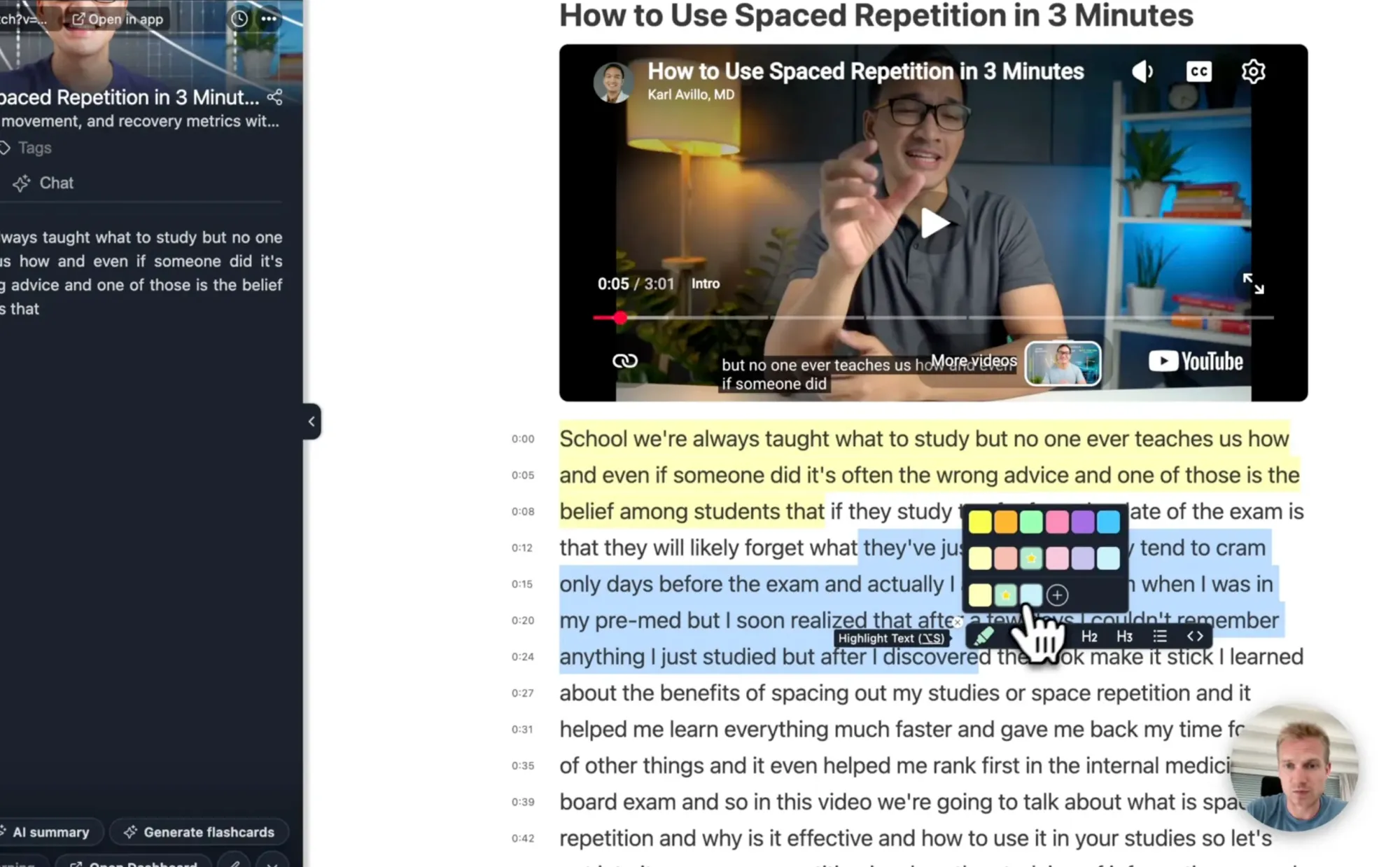
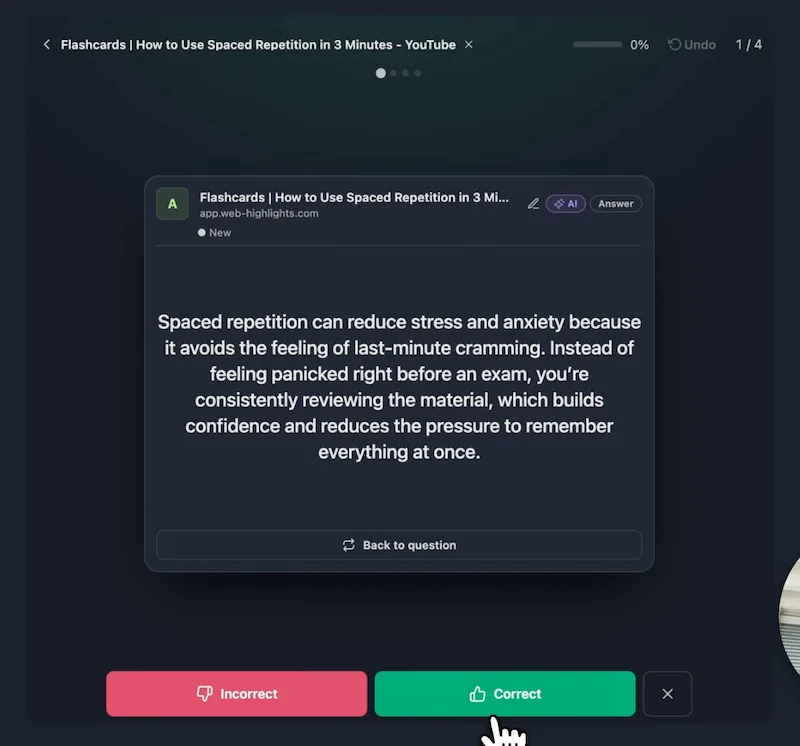
That part is just active reading: highlight what matters while the video runs, in as many colors as you like — one for the ideas you want to keep, another for whatever you want to look up later. Then turn the most important highlights into flashcards. The highlight is already the answer, so all you write is the question on the front.
And that's it. The next day the cards come back and ask you, and you answer before you reveal anything.
If you prefer watching to reading, here is the whole thing in a few minutes:
The source doesn't really matter — articles, PDFs and lecture slides all work the same way. There is a longer walkthrough for YouTube videos , and if you learn a lot from AI chats, the same example with ChatGPT conversations .
Active Recall + Spaced Repetition: The Pair That Actually Sticks
Active recall answers how to review; spaced repetition answers when . Each successful retrieval lets you wait longer before the next one — a day, three days, a week, a month. Combined, they flatten the forgetting curve with the least possible effort.
If spaced repetition is new to you, I've covered it in depth here: How to Make Your Readings Stick in Long-Term Memory . The short version: reviewing at growing intervals is the "when," active recall is the "how," and you want both.
How I Practice Active Recall with Web Highlights
Web Highlights is a free browser extension I built that's now used by hundreds of thousands of people. It turns the loop above into something that happens while you read, not as a separate chore:
- Highlight anything — websites, PDFs, YouTube transcripts.
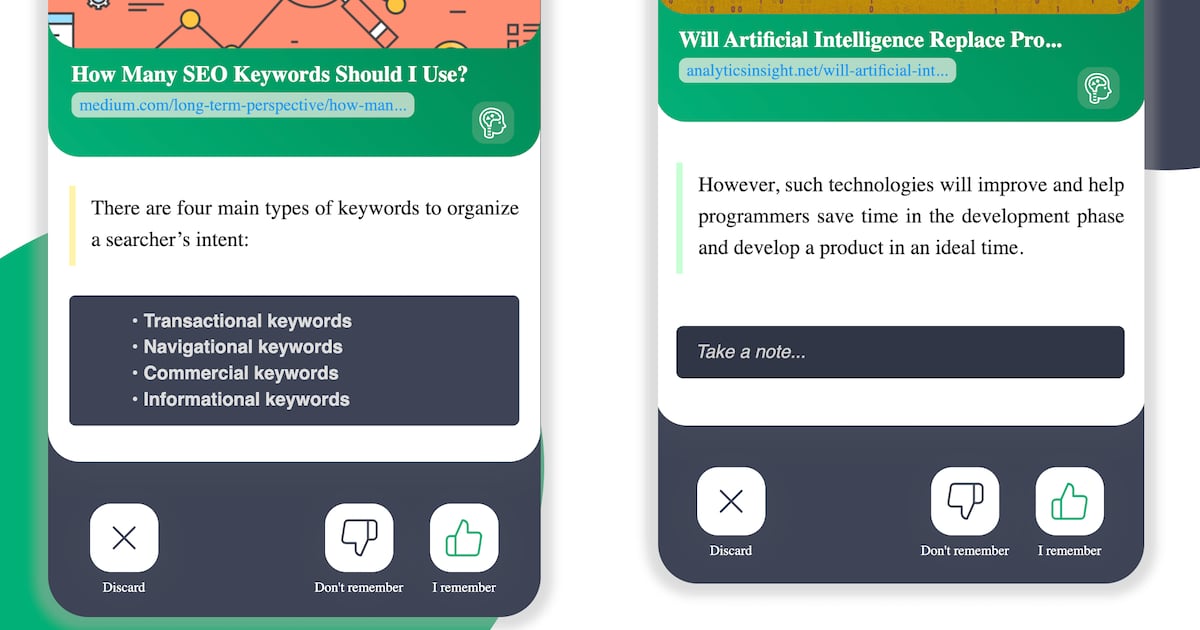
- Turn any highlight into a real flashcard: add a question, and the highlight's text becomes the editable answer. So you usually only phrase the question.
- Review in a spaced-repetition session. Cards with a question show the question first and flip to the answer — forced retrieval, not re-reading. Grade yourself "Correct" or "Incorrect" and the schedule adapts.
You can try the review flow without installing anything or creating an account: the free learner at app.web-highlights.com/learner lets you start with a ready-made deck — or generate cards from any website , a PDF , or a YouTube video . The AI that drafts the cards runs on your own device, not on a server. Ready-made study sets live on the learning paths hub .
Common Mistakes That Make Active Recall Feel Useless
- Peeking too early. If you check the answer after two seconds of "thinking," you're back to passive review. Give yourself a real moment to dig for it first.
- Only testing what you already know. It feels great and teaches nothing. The cards you keep getting wrong are the ones doing the work.
- Writing questions with the answer inside. "Why is active recall (testing yourself) effective?" — a question like that quizzes nothing; you're just re-reading with extra steps.
- Cramming all reviews into one evening. Retrieval works best spread out. Ten cards a day beats seventy on Sunday.
If more of your reading should survive the week, give the loop a try: install Web Highlights , turn your next ten highlights into questions, and review them tomorrow. That's it — no bigger commitment needed.
Thanks for reading! I'm happy to answer any questions, and I'm always open to criticism 😊
Want to learn more about how I built and grew my Chrome Extension as a solopreneur? Subscribe to my Medium , or follow me on LinkedIn and Twitter .