Advanced Devices
These 10 terms come up in the closest literary analysis — the vocabulary for describing HOW meaning is built, not just naming a comparison.
Practice this set for free — no account needed. Loads 10 flashcards into the learner.
Practice in the free learnerHow to study this set
Synecdoche and metonymy are easy to mix up — synecdoche uses a PART to represent the WHOLE ("wheels" for "car"); metonymy uses something closely ASSOCIATED with a thing ("the crown" for "the monarchy").
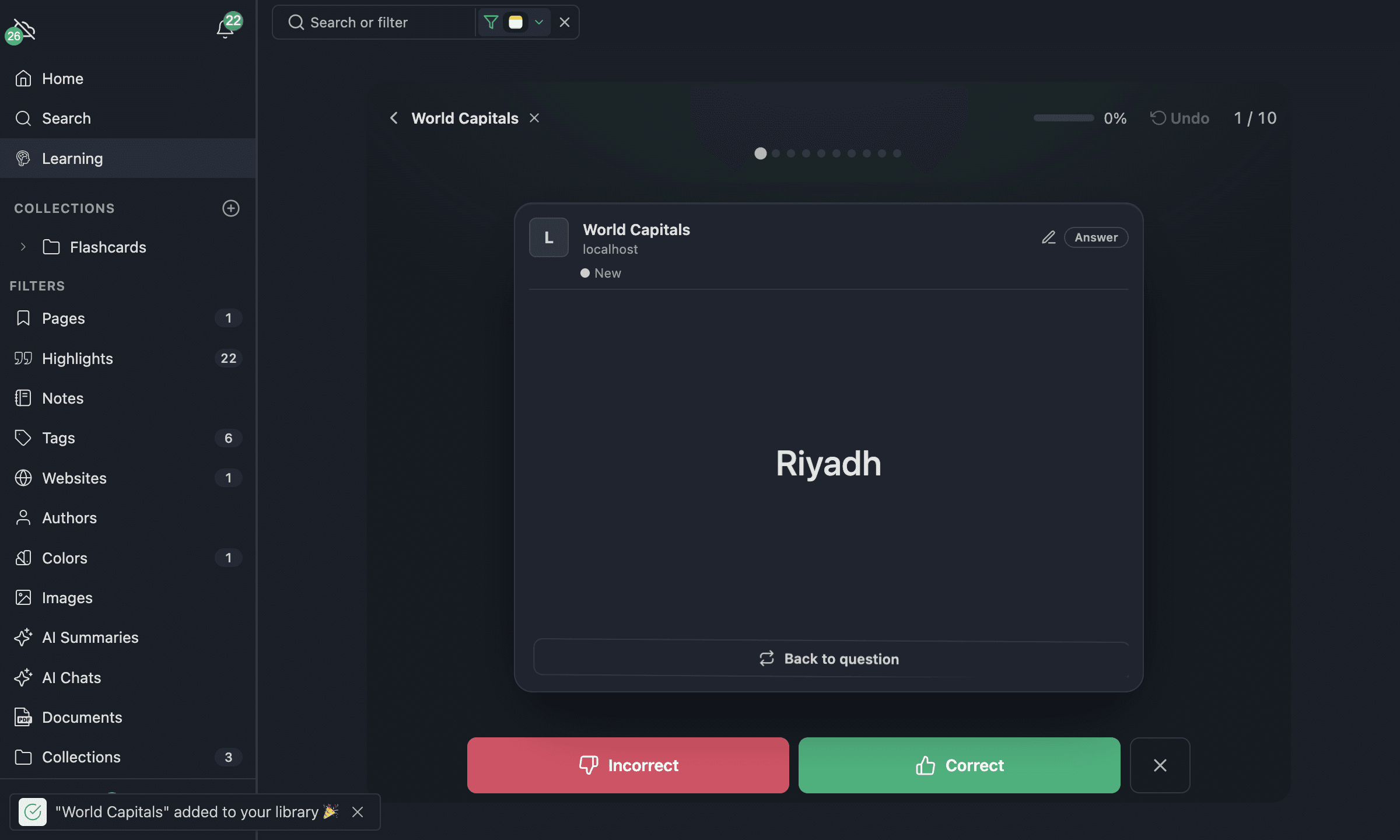
All 10 flashcards
Swap question and answerSynecdoche
Using a part of something to represent the whole (or vice versa).
"All hands on deck" uses "hands" to mean the sailors themselves.
Metonymy
Referring to something by the name of something closely associated with it.
"The White House announced..." uses the building to mean the administration.
Litotes
An understatement formed by negating the opposite, often for ironic effect.
"Not bad" meaning "quite good" is litotes.
Pathetic fallacy
Attributing human emotion to nature or the weather, often to reflect a character’s mood.
A storm breaking out during a character’s emotional collapse is pathetic fallacy.
Epiphany
A sudden moment of realization or insight experienced by a character.
A character’s abrupt understanding of their own mistake is an epiphany.
Catharsis
The emotional release an audience feels after experiencing intense emotions through a story, especially tragedy.
Aristotle described tragedy as producing catharsis through pity and fear.
Deus ex machina
An unexpected, often implausible event or character that suddenly resolves a story’s conflict.
A sudden rescue with no earlier setup is often criticized as deus ex machina.
Anachronism
Something placed in a time period where it does not belong.
The clock that strikes in Shakespeare’s Julius Caesar, a play set in ancient Rome, is an anachronism.
Red herring
A clue or detail deliberately included to mislead the reader.
A suspicious character introduced only to distract from the real culprit is a red herring.
Unreliable narrator
A narrator whose account of events cannot be fully trusted.
A narrator who later contradicts their own earlier claims signals they may be unreliable.
What to learn next
That completes Meaning and Structure Devices. Sound and Word Devices, in this same subject, covers the other half of literary analysis.