Key Passages and Exam Prep
These 10 questions cover the lines and scenes that come up most often in AP Literature and Common Core discussion of the play.
Practice this set for free — no account needed. Loads 10 flashcards into the learner.
Practice in the free learnerHow to study this set
Learn each quote together with WHO says it and WHY — an unattached quote is much less useful in an exam answer than one you can place in context.
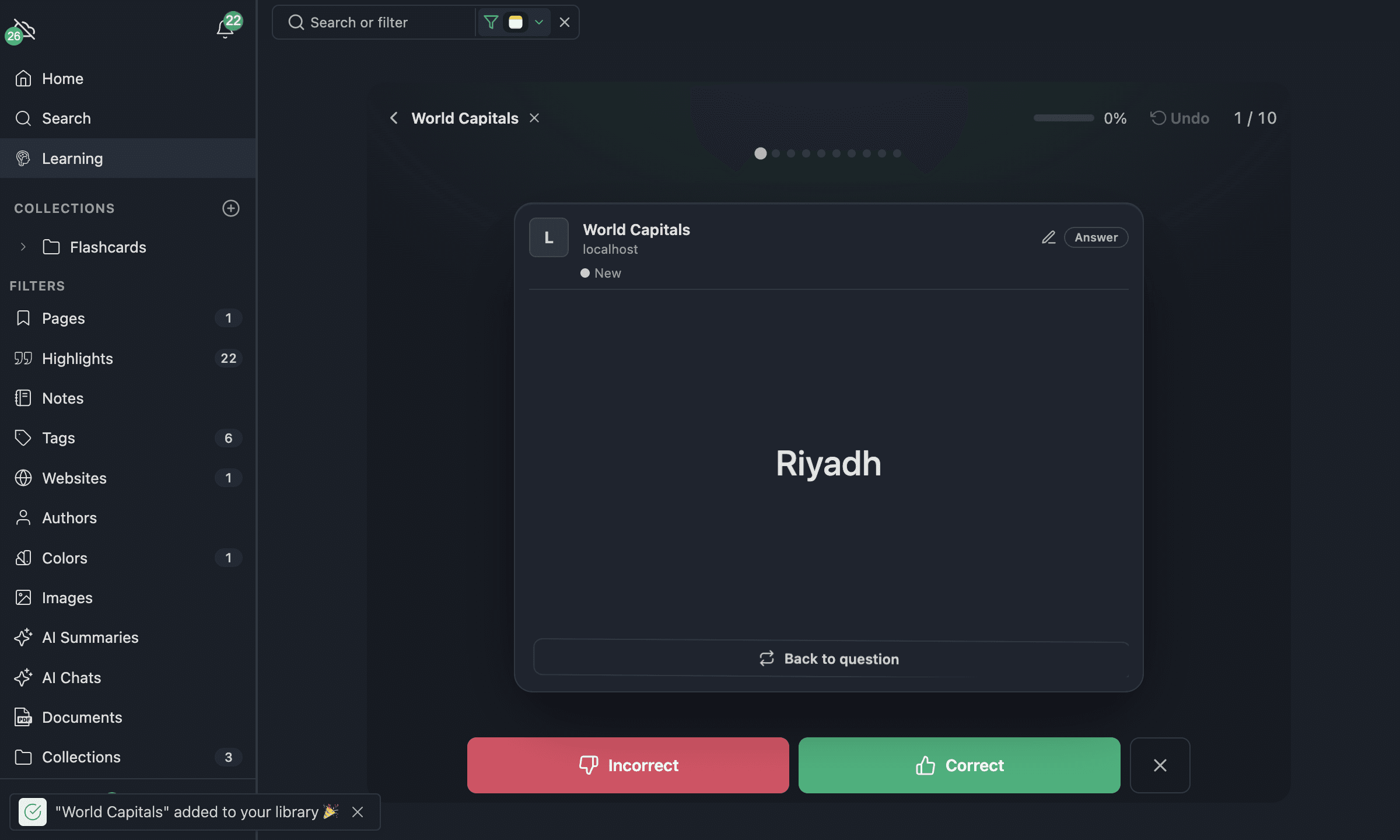
All 10 flashcards
What is Hamlet’s most famous soliloquy, by its opening line?
"To be, or not to be, that is the question."
Act 3, Scene 1 — Hamlet weighs the merits of life and death.
What does the "To be, or not to be" soliloquy actually weigh, in Hamlet’s own words?
Whether it is nobler to endure suffering, or to end it by dying — and what stops people from doing so.
He concludes that fear of the unknown after death ("the undiscovered country") holds people back.
What line does a guard use early in the play to describe the state of Denmark?
"Something is rotten in the state of Denmark."
Spoken by Marcellus in Act 1, Scene 4.
What does Polonius famously advise his son Laertes, in a line often quoted out of context?
"This above all: to thine own self be true."
Act 1, Scene 3 — part of a longer, somewhat pompous list of advice.
What does Hamlet say while holding the skull of the former court jester?
"Alas, poor Yorick! I knew him, Horatio."
Act 5, Scene 1, the graveyard scene.
What does Hamlet say about being ready for death, near the play’s end?
"The readiness is all" — meaning one must simply be prepared, since the timing is not in our control.
This reflects a shift in Hamlet’s attitude toward fate by Act 5.
What does Hamlet call the world, reflecting his despair, using a gardening metaphor?
He calls it "an unweeded garden that grows to seed," full of things "rank and gross in nature."
Act 1, Scene 2 — one of his early soliloquies, before he even meets the ghost.
What final request does Hamlet make of Horatio as he is dying?
To live on and tell his story accurately to the world.
"Report me and my cause aright," roughly.
Why is the exact wording of many famous Hamlet lines sometimes slightly different across editions?
Because the play survives in multiple early printed texts (quartos and the First Folio) with small differences.
Scholars still debate which version most closely reflects Shakespeare’s intentions.
Why is Hamlet frequently chosen for AP Literature and exam study over Shakespeare’s other tragedies?
Its psychological depth, ambiguity and quotability give it unusually rich material for close reading and essay questions.
It also has a very active critical tradition to draw from, useful for scaffolding an essay.
What to learn next
That completes Hamlet. The Literary Devices set pairs well with it for exam-style analysis questions.