APIs & Databases
A web page is only the surface; behind it sits the data and the plumbing that moves it around. APIs are the agreed-upon doorways through which one program asks another for information, and databases are where that information is stored so it survives after the page closes. This final set covers the back-end vocabulary that ties the two together — REST and JSON for talking between systems, SQL and NoSQL for storing data, and the CRUD operations every application performs on it. Master these and you can see the full round trip: a click, a request to an API, a query to a database, and data on its way back.
Practice this set for free — no account needed. Loads 16 flashcards into the learner.
Practice in the free learnerHow to study this set
Keep the two halves of this set straight by asking of each term, “is this about moving data or storing it?” APIs, REST, JSON and endpoints move data between programs; databases, SQL, NoSQL, primary keys and CRUD are about storing and retrieving it. Sorting each card into that pair fixes it in the right place.
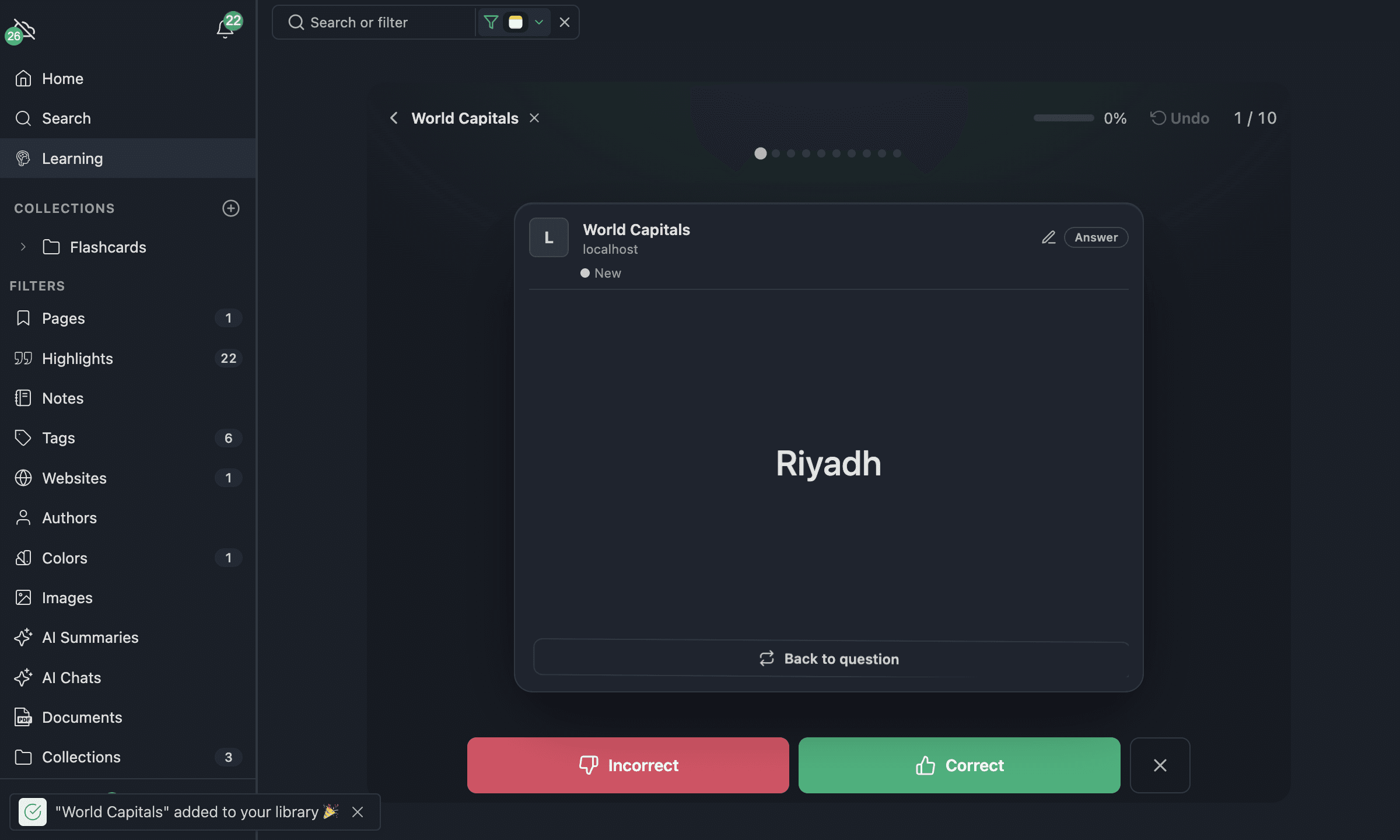
All 16 flashcards
What is an API?
An Application Programming Interface — a defined way for two programs to communicate and exchange data
What is a web API?
An API accessed over HTTP that lets a client request data or actions from a server
What is REST?
Representational State Transfer — a common style for web APIs that uses HTTP methods and URLs to work with resources
What is an API endpoint?
A specific URL where an API receives requests for a particular resource or action
What is JSON?
JavaScript Object Notation — a lightweight, text-based format for exchanging structured data
Why is JSON so widely used by web APIs?
It is human-readable and easy for programs to both generate and parse
What is a database?
An organised collection of data stored so it can be queried and updated efficiently
What is a relational (SQL) database?
A database that stores data in tables of rows and columns and is queried with SQL
What does SQL stand for?
Structured Query Language — the language used to query relational databases
What is a NoSQL database?
A non-relational database that stores data in flexible formats such as documents or key–value pairs
What is one key difference between SQL and NoSQL databases?
SQL databases use fixed table schemas, while NoSQL databases are more flexible and often schema-less
What does CRUD stand for?
Create, Read, Update and Delete — the four basic operations on stored data
What is a primary key?
A column (or set of columns) whose value uniquely identifies each row in a table
In a relational database, what is a “table”?
A collection of related data organised into rows and columns
What is a database query?
A request sent to a database to retrieve or modify data
In a REST API, which HTTP method usually corresponds to the “Read” in CRUD?
GET
What to learn next
That completes the Web Development path — from the request–response cycle, through the front-end trio, to the APIs and databases underneath. Keep all three decks in review, and revisit the Fundamentals category to keep the core computer-science concepts sharp.