Conditional Logic
Conditional logic is the closest thing the LSAT has to mathematics: a small set of rules that, once internalised, produce certain answers instead of judgement calls. Everything reduces to one structure — a sufficient condition guarantees a necessary one — plus one safe inference, the contrapositive, and two seductive invalid ones. The hard part is translation: "only if", "unless" and "no A are B" all encode conditionals, and the exam counts on you translating them wrong under pressure.
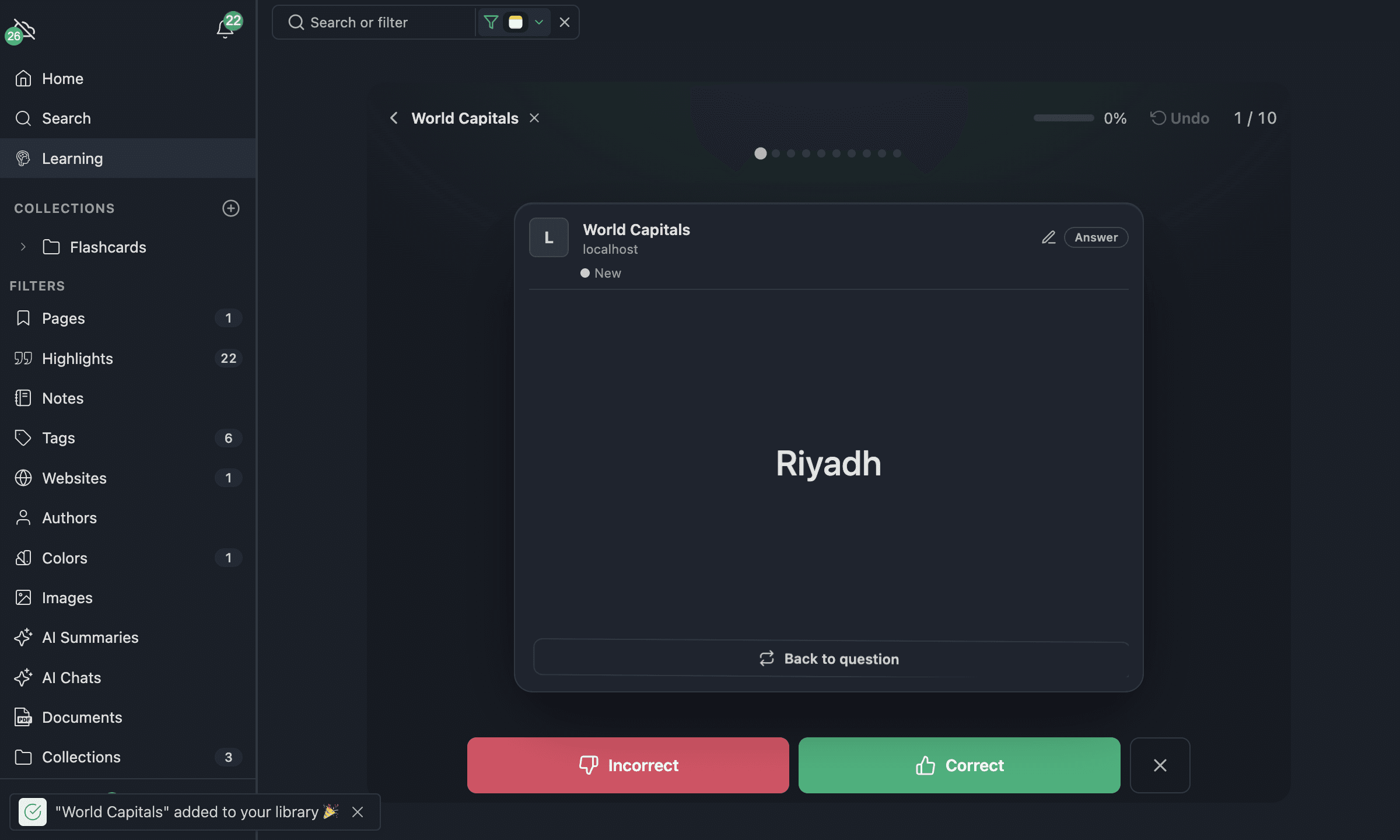
Practice this set for free — no account needed. Loads 13 flashcards into the learner.
Practice in the free learnerHow to study this set
Drill the translations until they are reflexes, not derivations — "unless" alone is worth several points across a test. For every conditional card, recite the contrapositive along with the original: A→B and not-B→not-A are one fact wearing two shirts, and answering with both cements the habit the exam rewards.
All 13 flashcards
In "if A, then B" — which condition is sufficient and which is necessary?
A is sufficient (it guarantees B); B is necessary (required whenever A holds). Sufficient triggers, necessary follows.
What is the contrapositive of "if A, then B"?
"If not B, then not A" — reverse AND negate. It is the only guaranteed inference from a conditional.
Why is concluding "A" from "if A then B" plus "B is true" invalid?
That is the converse error (affirming the necessary): B can hold for countless other reasons — rain guarantees wet streets, but wet streets do not guarantee rain.
Why is concluding "not B" from "if A then B" plus "A is false" invalid?
That is the inverse error (denying the sufficient): losing one guarantee of B does not eliminate B — the streets can be wet without rain.
What does "only if" introduce?
The NECESSARY condition. "A only if B" translates to A→B — not B→A, which is the classic trap.
How do you translate "A unless B"?
Negate one side and make it sufficient: "if not B, then A". "The picnic happens unless it rains" = if it does not rain, the picnic happens.
How do you translate "No As are Bs"?
As a conditional: A→not B (and by contraposition, B→not A). "No reptiles are warm-blooded" = if reptile, then not warm-blooded.
Given "A→B" and "B→C", what can you conclude?
A→C — conditionals chain when the necessary of one is the sufficient of the next. Long chains are just this move repeated.
Which everyday words introduce a SUFFICIENT condition?
"If", "when", "whenever", "all", "any", "every", "each" — what follows them triggers the rest of the statement.
Which everyday words introduce a NECESSARY condition?
"Only", "only if", "must", "requires", "depends on" — what follows them is the requirement.
What is a biconditional?
"A if and only if B" — each side is both sufficient and necessary for the other: A→B and B→A. They stand or fall together.
Sufficient vs necessary in one plain sentence each?
Sufficient: enough on its own to guarantee the result. Necessary: required for the result, but no guarantee of it.
"All scholarship recipients are seniors. Maria is a senior." What follows?
Nothing — being a senior is the necessary condition, and affirming it proves nothing about Maria's scholarship (converse error in the wild).
What to learn next
With the machinery in place, finish with level 5, "Question-Type Strategies" — the per-question playbook (negation test, strengthen/weaken tactics, wrong-answer patterns) that turns all this theory into points.
Continue to Level 5: Question-Type Strategies →