Judicial Review & Government
A constitution that no one can enforce is just a wish list. This final set is about the machinery that gives it teeth and keeps government within its bounds: judicial review, the supremacy of the constitution over ordinary statutes, the way laws are actually made, and how power is distributed and altered. These are the mechanisms taught in every constitutional-law course, described in general terms so they apply whether a country is large or small, federal or unitary. Master them and you can trace how an idea becomes a binding law — and how a court can stop that law if it breaks the constitution.
Practice this set for free — no account needed. Loads 15 flashcards into the learner.
Practice in the free learnerHow to study this set
Think in terms of “who can stop whom”: a legislature makes a statute, but a court exercising judicial review can strike it down if it conflicts with the constitution. Trace the life of a law from bill to enactment as a sequence you can recite. For federalism, keep asking where a given power sits — with the central government, the regions, or shared between them.
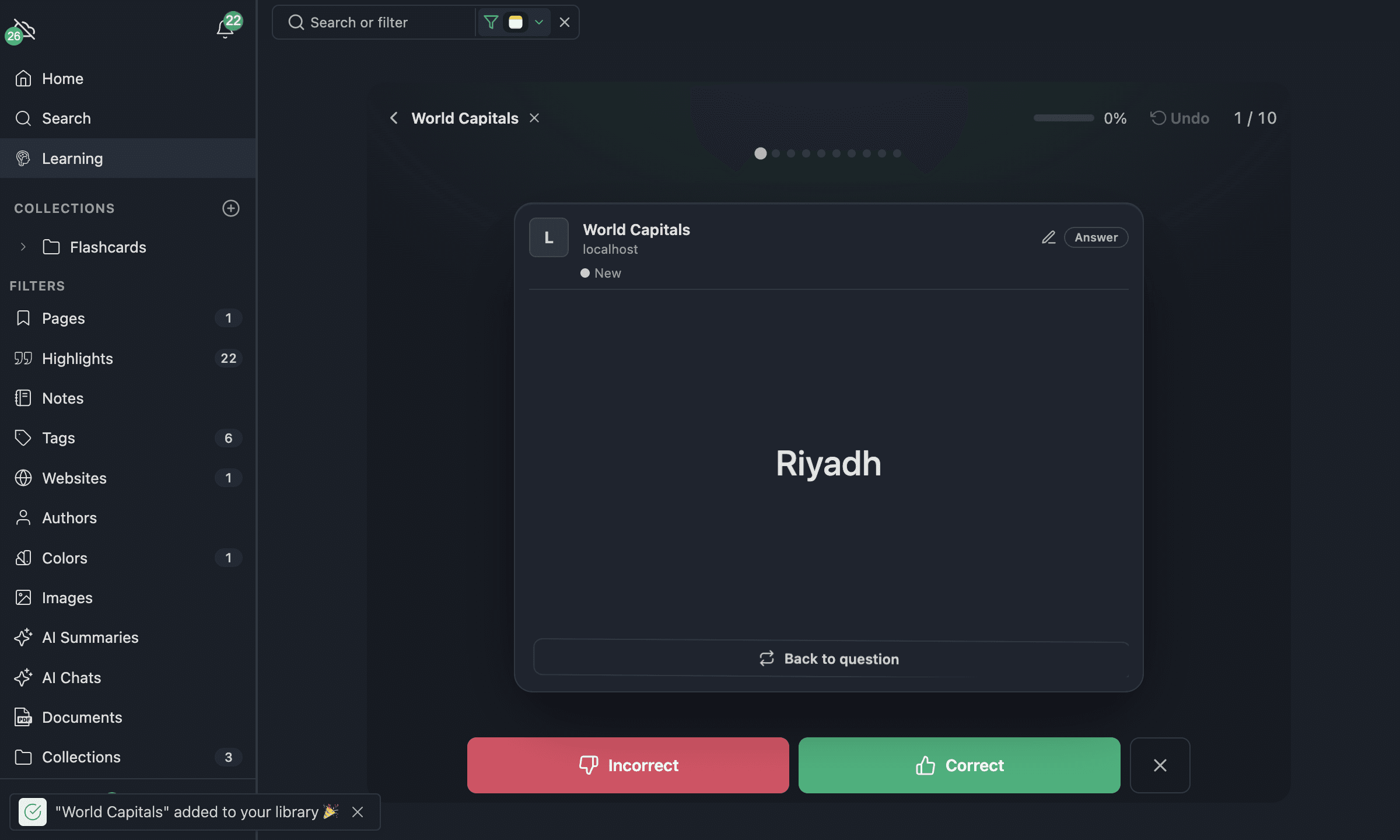
All 15 flashcards
What is judicial review?
The power of courts to examine laws or acts of government and set them aside if they conflict with the constitution
What can a court do with a statute it finds unconstitutional?
Declare it invalid so that it cannot be enforced, because the constitution outranks ordinary legislation
Why can a constitution override a statute passed by the legislature?
Because the constitution is the supreme law, and any statute that conflicts with it has no legal force to that extent
What is a constitutional (or supreme) court?
The highest court responsible for interpreting the constitution and ruling on whether laws and government acts comply with it
Some states have a dedicated constitutional court; in others the ordinary supreme court performs this role.
What is a bill?
A proposed law placed before the legislature for consideration
It becomes a statute (an Act) only once it is enacted.
In general terms, how does a bill become law?
It is introduced and debated in the legislature, amended and approved, and then formally enacted — often requiring assent from the head of state
In a bicameral legislature, what does “bicameral” mean?
That the legislature has two chambers (houses), both of which usually take part in passing legislation
A one-chamber legislature is called unicameral.
What is the difference between a federal and a unitary system?
In a federal system power is constitutionally divided between a central government and regional governments; in a unitary system power is concentrated in the central government, which may delegate it
What is federalism?
A system in which sovereignty is shared between a central authority and constituent regions, each with its own sphere of powers
What typically happens when a regional law conflicts with valid central law in a federal system?
The valid central law generally prevails to the extent of the conflict, under the constitution’s allocation of powers
What is a constitutional amendment?
A formal change to the text or meaning of a constitution, made through the special procedure the constitution itself lays down
Why is amending a constitution usually harder than passing an ordinary law?
Because rigid constitutions require a special procedure — such as a supermajority or a referendum — to keep the fundamental law stable and above everyday politics
What is the doctrine of the separation of powers meant to prevent at this level?
It stops the courts, the legislature and the executive from absorbing one another’s functions, preserving an independent judiciary that can review the others
What does judicial independence require?
That judges decide cases free from pressure or control by the government or other parties, so the law is applied impartially
What is the difference between a court “interpreting” and “striking down” a law?
Interpreting means deciding what a valid law means and how it applies; striking down means declaring a law invalid because it breaches the constitution
What to learn next
You have now worked through constitutional law from the ground up — its structure, its rights, and the courts that enforce it. Keep these decks in your review rotation, and explore the other Law School categories to widen your foundation.