HTML, CSS & JavaScript
Every web page you have ever opened is built from three languages doing three different jobs. HTML lays out the structure and content, CSS handles how it all looks, and JavaScript makes it do things. Keeping those roles straight is the single most useful idea in front-end development — it tells you which file to open when you want to change a heading, a colour, or a button’s behaviour. This set locks in that division of labour and the handful of terms (tags, elements, selectors, the DOM, events) you meet the moment you start building.
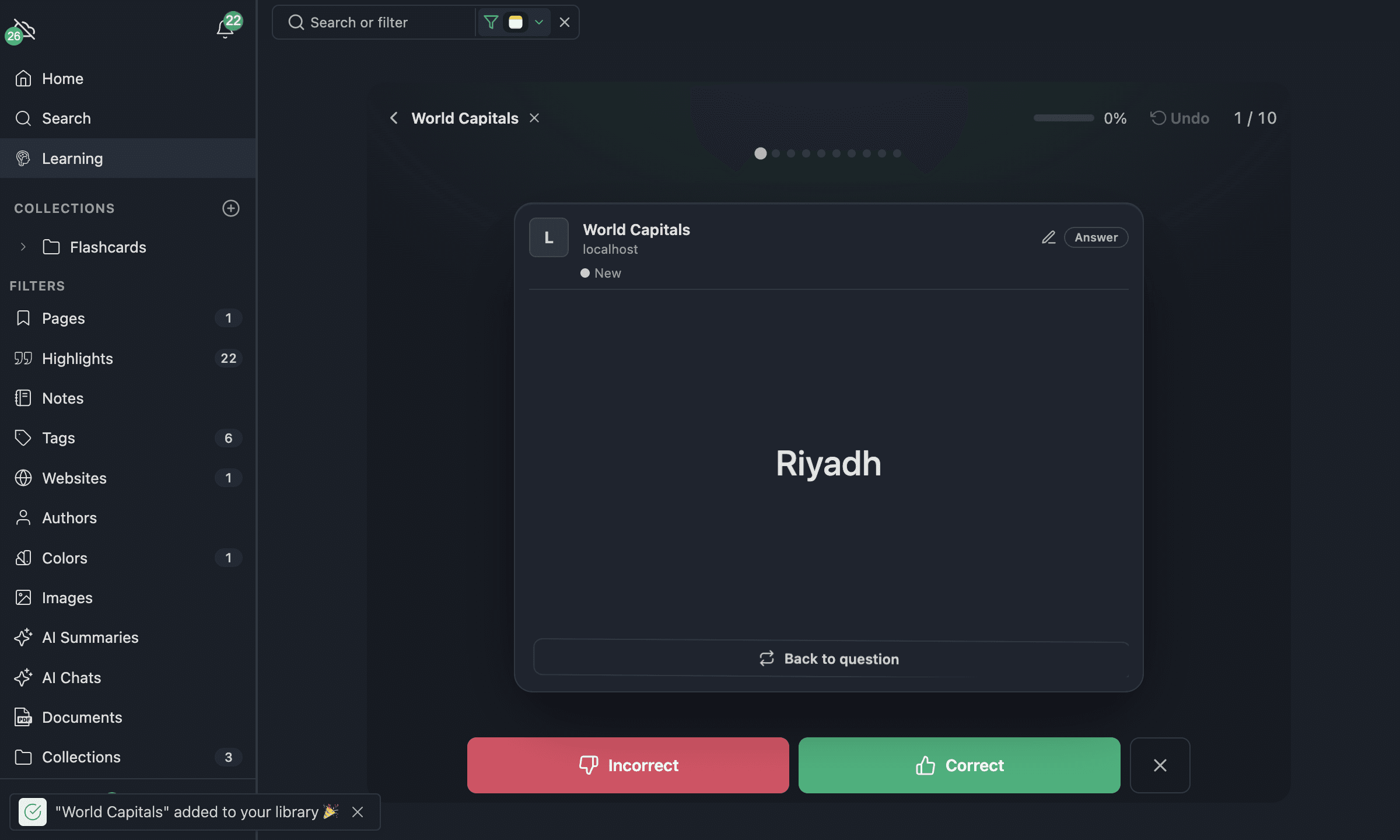
Practice this set for free — no account needed. Loads 16 flashcards into the learner. The learner asks it as shown here: phrase first, meaning second.
Practice in the free learnerHow to study this set
For each concept, name which of the three languages it belongs to before you recall the definition — a selector is CSS, an event is JavaScript, a tag is HTML. Sorting every term into structure, style or behaviour keeps them from blurring together and mirrors how you will actually reach for them.
All 16 flashcards
Swap question and answerHyperText Markup Language — it defines the structure and content of a web page
What does HTML stand for, and what is its job?
Cascading Style Sheets — it controls how a page looks: colours, fonts, spacing and layout
What does CSS stand for, and what is its job?
It adds behaviour and interactivity — responding to clicks, updating content, and more
What is JavaScript’s job on a web page?
HTML is structure, CSS is style, and JavaScript is behaviour
In the classic split of the three front-end languages, which handles structure, which style, and which behaviour?
A keyword wrapped in angle brackets, such as <p>, that marks the start or end of an element
What is an HTML tag?
A piece of content defined by an opening tag, its content, and a closing tag — for example <p>text</p>
What is an HTML element?
Extra information placed inside an opening tag, such as the href on an <a> link
What is an HTML attribute?
A pattern that chooses which HTML elements a block of styles should apply to
What is a CSS selector?
Every element that has the class “menu”
In CSS, what does a selector beginning with a dot, like “.menu”, target?
The single element whose id is “header”
In CSS, what does a selector beginning with a hash, like “#header”, target?
The Document Object Model — a tree representation of the page that JavaScript can read and change
What is the DOM?
An action or occurrence, such as a click or key press, that code can respond to
In web development, what is an “event”?
Code that runs in response to a specific event
What is an event listener (or event handler)?
Pre-written code that provides structure and tools to build web interfaces more quickly and consistently
What is a JavaScript framework or library, such as React?
A popular JavaScript library for building user interfaces from reusable components
What is React?
CSS
Which of the three front-end languages would you edit to change a page’s colours and layout?
What to learn next
With the front end in hand, level 3, "APIs & Databases", turns to the back end — where the data your pages display is stored and served.
Continue to Level 3: APIs & Databases →