How the Web Works
Type an address, press Enter, and a page appears — but a lot happens in that fraction of a second. Your browser looks up where the site lives, opens a conversation with a distant computer, asks for a page, and paints what comes back. This first set demystifies that conversation: the client and the server, the HTTP messages that pass between them, the URL that names what you want, and the status codes the server uses to report how things went. None of it requires writing code — it is the map of the territory every web developer works in.
Practice this set for free — no account needed. Loads 16 flashcards into the learner. The learner asks it as shown here: phrase first, meaning second.
Practice in the free learnerHow to study this set
Whenever a term comes up, trace it through one real page load in your head: you (the client) ask a server for a URL, DNS finds its address, an HTTP request goes out, and a response comes back with a status code. Fitting each card into that single story makes the whole set click into place at once.
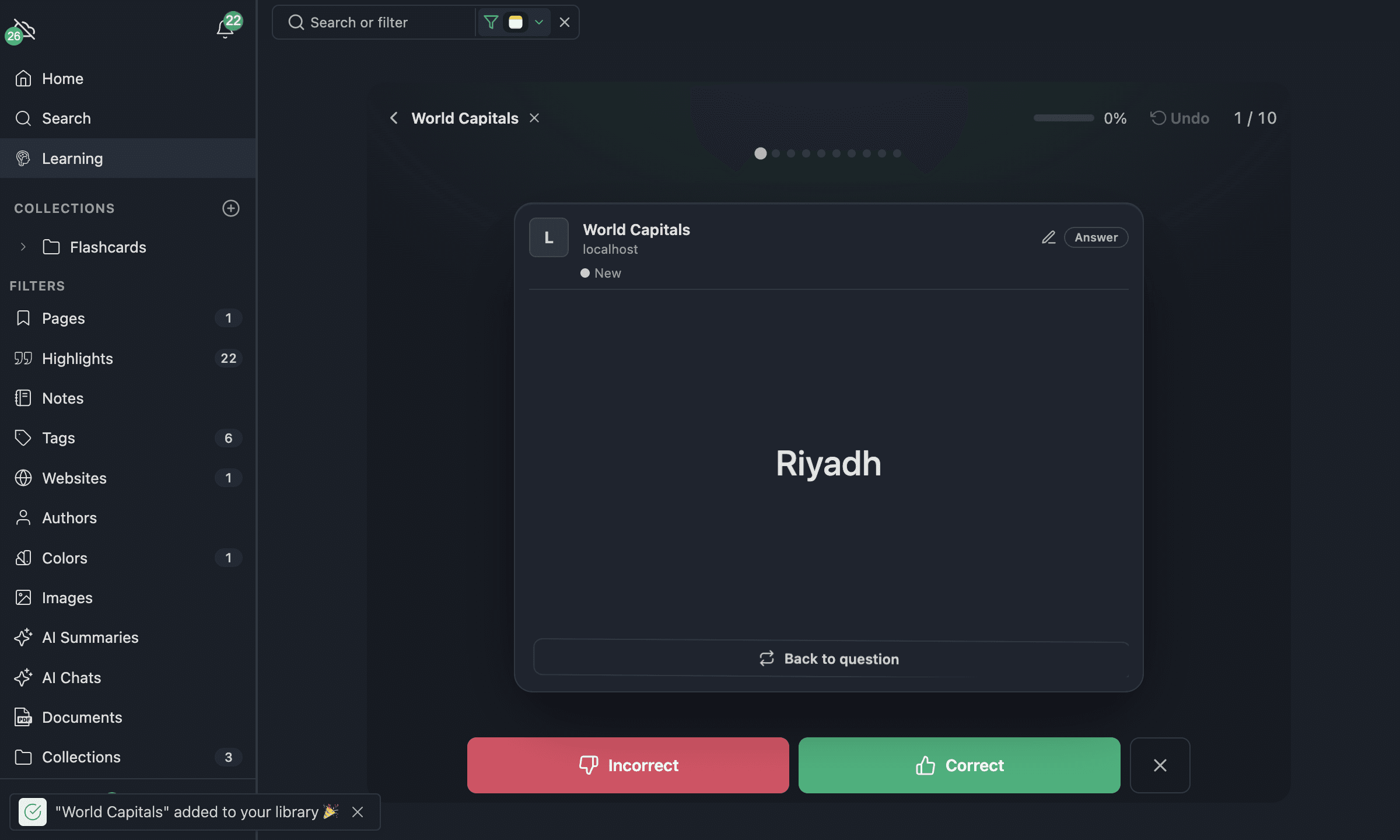
All 16 flashcards
Swap question and answerA program — usually a web browser — that requests resources from a server
In web terms, what is a “client”?
A computer or program that stores resources and responds to client requests over a network
What is a “server” on the web?
An arrangement where clients request services or resources and servers provide them
What is the client–server model?
HyperText Transfer Protocol — the set of rules browsers and servers use to exchange web pages and data
What does HTTP stand for and do?
Encryption, so data sent between the browser and server is private and hard to tamper with
What does HTTPS add compared with HTTP?
The “S” stands for Secure; it is HTTP layered over TLS/SSL.
A message a client sends to a server asking for a resource or action
What is an HTTP request?
The message a server sends back, containing a status code and usually the requested content
What is an HTTP response?
A Uniform Resource Locator — the address that identifies a resource on the web
What is a URL?
For example, https://example.com/page.
The Domain Name System, which translates human-readable domain names into IP addresses
What is DNS?
A numerical label that identifies a device on a network
What is an IP address?
Requests web pages and renders their HTML, CSS and JavaScript into the page you see
What does a web browser do?
OK — the request succeeded
What does the HTTP status code 200 mean?
Not Found — the server could not find the requested resource
What does the HTTP status code 404 mean?
Internal Server Error — something went wrong on the server
What does the HTTP status code 500 mean?
To retrieve or read data from a server without changing it
What is an HTTP GET request used for?
To send data to a server, typically to create or submit something
What is an HTTP POST request used for?
What to learn next
Now that you can follow a page from address bar to screen, level 2, "HTML, CSS & JavaScript", opens up what actually arrives — the three front-end languages that build the page your browser renders.
Continue to Level 2: HTML, CSS & JavaScript →