Academic Vocabulary
Academic writing has its own vocabulary — precise words like ambiguous, coherent and empirical that let you make careful distinctions a plainer word cannot. These are the words that lift an essay from clear to convincing, and they turn up constantly in exams, textbooks and reports. This set gives you the core academic vocabulary, each word defined simply and shown in a sentence you might actually write.
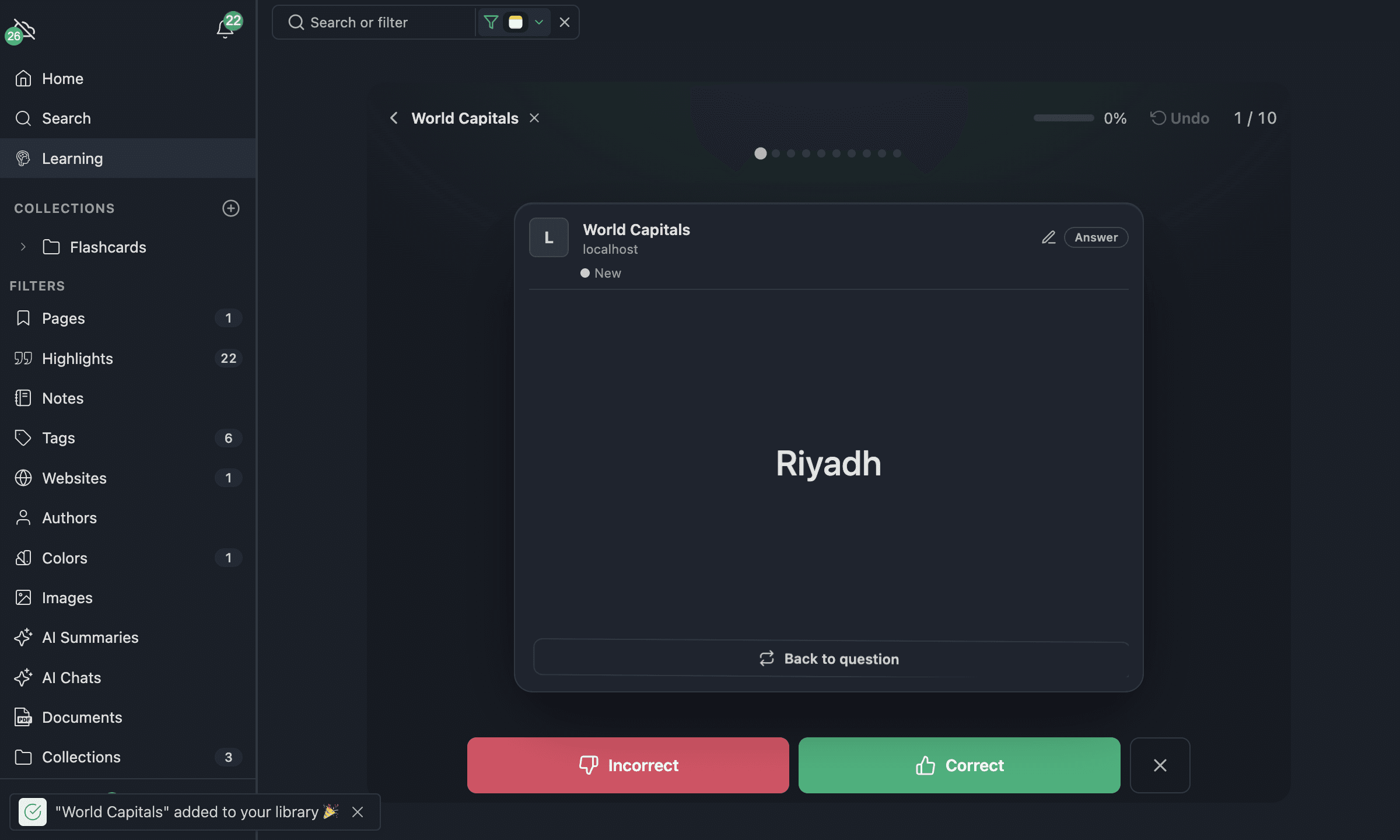
Practice this set for free — no account needed. Loads 15 flashcards into the learner. The learner asks it as shown here: phrase first, meaning second.
Practice in the free learnerHow to study this set
Learn the opposites and near-synonyms together: explicit vs implicit, objective vs subjective. Knowing where a word sits against its neighbours is what lets you pick exactly the right one in an essay. Try slotting each word into a sentence about something you are studying now.
All 15 flashcards
Swap question and answerOpen to more than one interpretation; unclear
What does “ambiguous” mean?
The instruction was ambiguous, so half the class did it wrong.
Giving a lot of information clearly and in few words
What does “concise” mean?
Her concise summary fit the whole report onto one page.
Seeming reasonable or probable
What does “plausible” mean?
It is a plausible explanation, but we still need evidence.
Based on random choice or personal whim rather than reason
What does “arbitrary” mean?
The deadline felt arbitrary, with no reason behind the date.
Logical and consistent; with clearly connected parts
What does “coherent” mean?
A coherent argument leads the reader step by step.
Based on observation or experiment rather than pure theory
What does “empirical” mean?
The claim is backed by empirical evidence from the trials.
Stated clearly and in detail, leaving no room for doubt
What does “explicit” mean?
The guidelines were explicit about the word limit.
Implied or understood though not directly stated
What does “implicit” mean?
There was an implicit assumption that everyone agreed.
Coming after something else in time; following
What does “subsequent” mean?
These points are developed in subsequent chapters.
A statement that seems self-contradictory but may nevertheless be true
What does “paradox” mean?
It is a paradox that sometimes less really is more.
To examine something closely and critically
What does “scrutinize” mean?
The auditors scrutinized every line of the accounts.
To provide evidence to support or prove a claim
What does “substantiate” mean?
She could not substantiate the theory with any data.
To make something less severe, serious or painful
What does “mitigate” mean?
The plan includes steps to mitigate the flood risk.
Existing as a natural, permanent part of something
What does “inherent” mean?
There are inherent risks in any extreme sport.
Not influenced by personal feelings; based on facts
What does “objective” (adjective) mean?
An objective assessment ignores who wrote the essay.
What to learn next
With academic vocabulary at your command, the final level adds range and colour. Level 3 covers advanced words that make your English precise, expressive and memorable.
Continue to Level 3: Advanced Vocabulary →